
Executive summary
- What counts: ordinary and necessary costs of running your business, and only the business share of anything you also use personally.
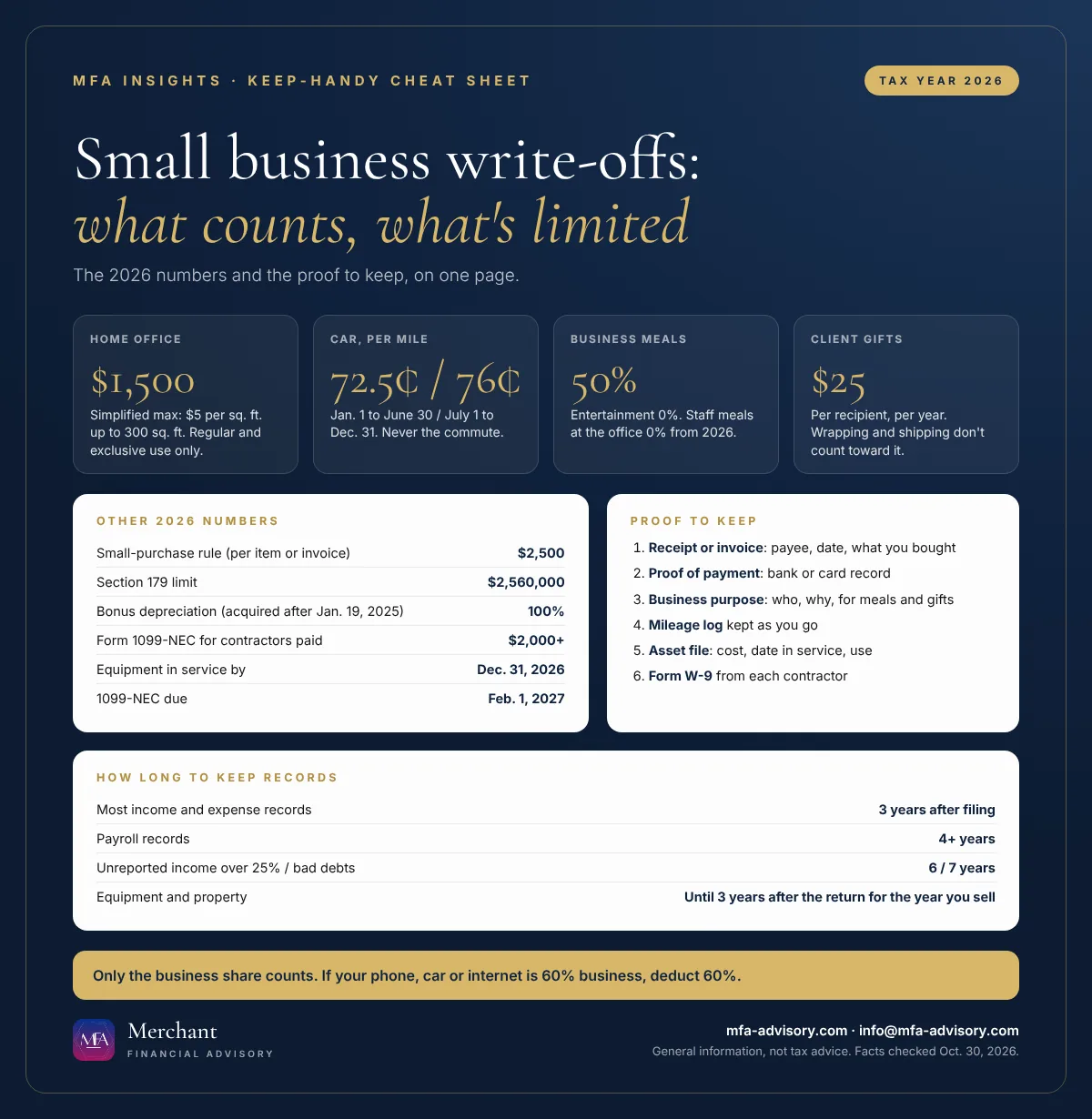
- What's limited: business meals are 50%, entertainment is 0%, client gifts top out at $25 per person, and the simplified home office deduction is capped at $1,500.
- Two 2026 changes: the business mileage rate rose midyear from 72.5 cents to 76 cents a mile on July 1, and snacks and meals you provide staff at the office are no longer deductible.
- Proof: every write-off needs a document showing who you paid, how much, when, and what it was for. Keep records at least 3 years (4 for payroll).
Bottom line: Most write-offs are lost to missing paperwork or personal use, not to obscure rules. Check any expense in our Is It Deductible? tool before Dec. 31.
"Can I write that off?" is the question we hear most in the last two months of the year. This guide to small business tax write-offs for 2026 covers what generally counts, the limits that trip owners up, and the proof the IRS expects for each one. If you want a quick yes or no on a specific expense, look it up in our Is It Deductible? tool, which covers 59 common expenses with the 2026 rule and the record to keep for each.
What can I write off as a small business owner?
A business expense is deductible when it is ordinary (common and accepted in your line of work) and necessary (helpful and appropriate for the business; it doesn't have to be required). Three rules narrow that down:
- Personal, living and family costs never count, even if you pay them from the business account.
- Mixed-use items count only for the business share. If your phone is 60% business, 60% of the bill is the write-off.
- Long-lived items are assets, not expenses. Equipment and furniture are capitalized and then deducted through depreciation, Section 179 or the small-purchase rule below.
Small business tax write-offs for 2026 at a glance
| Expense | 2026 rule | Proof to keep |
|---|---|---|
| Home office | Simplified method: $5 per sq. ft., up to 300 sq. ft. ($1,500 max). Space must be used regularly and exclusively for business. | Floor plan or measurements, photos of the space |
| Car (standard mileage) | 72.5 cents a mile Jan. 1 to June 30; 76 cents July 1 to Dec. 31. Business parking and tolls on top. Commuting never counts. | Mileage log: date, destination, business purpose, miles |
| Business meals | 50%, including tax and tip, with a business reason and you or an employee present | Itemized receipt plus who attended and what was discussed |
| Entertainment | 0% (tickets, golf, shows). Food bought separately at the event can be a 50% meal. | Separate receipt for any food |
| Snacks and meals for staff at the office | 0% for amounts paid after Dec. 31, 2025 (was 50%) | Code them to a separate account |
| Client gifts | $25 per recipient per year | Receipt and the recipient's name |
| Equipment up to $2,500 per item or invoice | Deductible right away under the de minimis safe harbor (an annual election) | Invoice and proof of payment |
| Larger equipment and vehicles | Section 179 up to $2,560,000; 100% bonus depreciation for property acquired after Jan. 19, 2025 | Invoice, contract date, placed-in-service date |
| Contractors | Fully deductible; Form 1099-NEC required at $2,000 or more paid in 2026 | Form W-9, invoices, payment records |
| Software, phone, internet | Deductible; only the business share if you also use them personally | Bills and a note of your business-use percentage |
What's limited or changed for 2026
The mileage rate changed midyear
The IRS set the 2026 business standard mileage rate at 72.5 cents a mile in Notice 2026-10, then raised it to 76 cents for driving on or after July 1, 2026 (Announcement 2026-11). Your log needs to split miles before and after July 1, so total them by half-year. If you own the car, you must choose the standard rate in the first year you use it for business to keep that option in later years.
Meals: 50% for clients, 0% for in-office staff meals
Business meals with clients, customers or prospects are still 50% deductible. What changed is food you provide employees at work: for amounts paid after 2025, coffee, snacks and meals provided through an on-site eating facility, as small (de minimis) perks, or for the employer's convenience are no longer deductible, apart from a few narrow exceptions in the law. Code these to their own account so they don't sit in "Meals" and get claimed at 50% by mistake.
Equipment: the generous rules are permanent
100% bonus depreciation is now permanent for qualifying property acquired after Jan. 19, 2025, and the Section 179 limit is $2,560,000 for tax years beginning in 2026, phased out above $4,090,000 of purchases. The asset must be placed in service (set up and ready to use) by Dec. 31, 2026. For New Jersey small businesses, the state doesn't follow federal bonus depreciation and caps Section 179 far lower, so your NJ deduction will differ. Our Section 179 vs. bonus depreciation guide walks through which to use and the New Jersey numbers.
Home office: an income limit, too
Beyond the $1,500 cap on the simplified method, neither method can create a loss from the home office: the deduction can't exceed the income from the business use of the home minus your other business expenses. W-2 employees can't claim it.
The proof to keep for each write-off
The IRS says your documents should show the payee, the amount paid, proof of payment, the date and a description that shows the cost was for the business. A card statement alone often doesn't show what you bought, so pair it with the receipt or invoice.
- Everyday expenses: invoice or receipt plus the bank or card record that paid it.
- Travel, meals, gifts and car: the amount, time, place and business purpose. For meals and gifts, note the business relationship of the person.
- Mileage: a log kept as you go, not rebuilt in April, with odometer readings at the start and end of the year.
- Equipment: when and how you acquired it, cost, Section 179 or depreciation claimed, how it was used, and later how and when you sold it.
- Contractors: a Form W-9 collected before the first payment.
How long to keep business tax records
| Situation | Keep for |
|---|---|
| Most income and expense records | 3 years after you file |
| Payroll (employment tax) records | At least 4 years after the tax is due or paid, whichever is later |
| Income you didn't report was more than 25% of gross income | 6 years |
| Bad debt or worthless securities deduction | 7 years |
| Equipment, vehicles and property | Until the period of limitations ends for the year you dispose of the asset |
| No return filed, or a fraudulent return | Indefinitely |
Common write-off mistakes we see at year-end
- Deducting the commute. Driving from home to your regular place of work is personal, however far it is.
- Writing off the whole phone or internet bill when part of it is personal.
- Lumping entertainment into meals. Tickets and outings are 0%, not 50%.
- Booking equipment as "office expense." Record it as a fixed asset so your books, depreciation schedule and return agree.
- Paying personal bills from the business account. It doesn't make them deductible, and it makes the books harder to defend. Our Schedule C guide for single-member LLCs shows where each cost belongs on the return.
Check any expense before Dec. 31
Our Is It Deductible? tool gives a plain-English answer (Yes, Partly or Usually not) for 59 common expenses, with the 2026 limit, an example and the record to keep. Want it on paper? Get the write-off checklist by email: a printable PDF of every expense to tick off this year and hand to whoever prepares your return.
FAQs
Ordinary and necessary business costs such as rent, software, supplies, contractors, advertising, insurance, the business share of your phone and car, a qualifying home office, 50% of business meals, and equipment through depreciation, Section 179 or the $2,500 small-purchase rule.
72.5 cents a mile for business driving from Jan. 1 to June 30, 2026, and 76 cents a mile from July 1 to Dec. 31, 2026.
Yes, for meals with clients, customers or prospects that have a business purpose. Meals and snacks provided to employees at the workplace are no longer deductible for amounts paid after 2025, and entertainment remains 0%.
With the simplified method, $5 per square foot for up to 300 square feet, so $1,500 at most. The regular method uses your actual home costs times the business-use percentage. Either way, the space must be used regularly and exclusively for business.
You need records that show who you paid, the amount, the date, proof of payment and that the cost was for business. Often that takes the receipt or invoice plus the bank or card record together.
Generally 3 years after you file, at least 4 years for payroll records, and longer for assets you still own, for underreported income (6 years) or bad debts (7 years).
Merchant Financial Advisory (MFA), an accounting and tax solutions provider in Princeton, New Jersey, helps individuals and small and mid-sized businesses in New Jersey, New York and nationwide keep clean books and claim every deduction they can support. See our bookkeeping services and our Form 1099 guide for 2026, or book a consultation.
Save the key dates
- Thu, Dec 31, 2026Last day to place equipment in service for a 2026 write-off Section 179, bonus depreciation and the $2,500 small-purchase rule all depend on the item being set up and ready to use by this date. Ordering it isn't enough.
Add to calendar
- Mon, Feb 1, 2027Form 1099-NEC due to contractors and the IRS For 2026 payments of $2,000 or more for services. January 31, 2027 is a Sunday, so the due date moves to Monday, February 1.
Add to calendar
Subscribe to every MFA key date
"Add all these dates" downloads one file that opens in Apple Calendar, Outlook or Google Calendar (in Google, use Settings, then Import). Subscribing works with Apple, Google and Outlook and updates itself whenever we publish a new deadline.
Get key tax dates and new articles by email
Every new MFA Insights article, the IRS, New Jersey and New York deadlines that matter, and a calendar you can save. For individuals and small and mid-sized businesses.
Almost done: check your inbox and click the confirmation link to join MFA Insights. (If you don't see it in a minute, check Promotions or Spam.)
Have a question about this?
Ask us privately. Your question goes straight to our inbox, not onto the page, and we reply by email within one business day. Please don't include Social Security or account numbers.
Thanks, your question is in. We'll reply by email within one business day.
Sources
- IRS: Instructions for Schedule C (Form 1040) (2025)
- IRS: Simplified option for home office deduction
- IRS IR-2025-128: 2026 business standard mileage rate of 72.5 cents (Notice 2026-10)
- IRS Internal Revenue Bulletin 2026-29: Announcement 2026-11 (76 cents from July 1, 2026)
- IRS Publication 463 (2025): Travel, Gift, and Car Expenses
- IRS Publication 15-B (2026): Employer's Tax Guide to Fringe Benefits
- IRS Rev. Proc. 2025-32: 2026 inflation adjustments (Section 179, sec. 4.24)
- IRS: Treasury, IRS issue guidance on the additional first-year depreciation deduction (Notice 2026-11)
- IRS Internal Revenue Bulletin 2015-50: Notice 2015-82 ($2,500 de minimis safe harbor)
- IRS: 2026 Instructions for Forms 1099-MISC and 1099-NEC
- IRS: What kind of records should I keep?
- IRS: How long should I keep records?
Facts checked against the sources above as of October 30, 2026. This article is general information, not tax, legal, or financial advice, and reading it does not create a client relationship. Tax rules change and every situation is different; confirm the details for your situation with a qualified professional before acting.