
Executive summary
- Self-employed? Yes, the business part. Freelancers, sole proprietors and single-member LLC owners deduct the business-use share of home internet on Schedule C. The personal part isn't deductible.
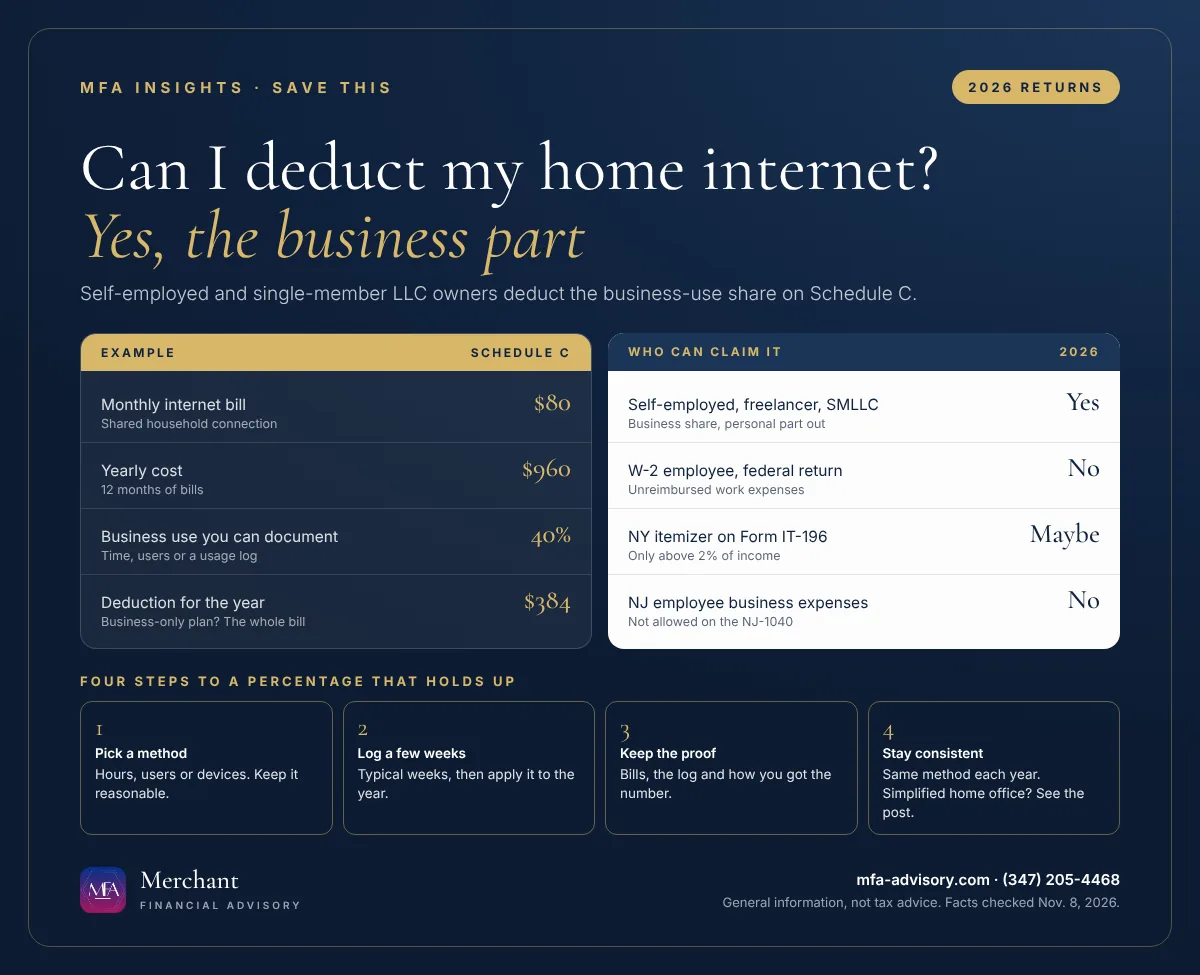
- $80 a month at 40% business use = $384 for the year. The percentage has to be one you can back up.
- W-2 employees generally can't deduct work-from-home costs on the federal return. New York itemizers have a narrow option; New Jersey doesn't allow it.
- Simplified home office method: $5 per square foot, up to 300 square feet, in place of actual home expenses such as utilities.
Bottom line: Pick a reasonable method, log a few typical weeks now, and keep the bills with your 2026 records.
Can I deduct my home internet for business? If you work for yourself, yes: you can deduct the share of your internet bill that serves the business. The IRS rule is simple. When an expense is partly business and partly personal, you separate the two, and the personal part is generally not deductible. The work is in figuring, and proving, the split.
Home internet tax deduction for the self-employed
To be deductible, a business expense has to be ordinary (common in your field) and necessary (helpful and appropriate for your business). For most freelancers, consultants and online sellers, internet clears that bar easily.
You claim it on Schedule C with your other business costs. If you add a separate internet plan that only the business uses, there's no personal part to split out, so the whole bill is a business expense. The IRS applies the same idea to phones: a second line used only for business is deductible, while the base rate of the first phone line into your home is not.
How much of my internet can I deduct for business?
Your internet business use percentage. The IRS doesn't publish a set formula for internet, so use a method that's reasonable and that you can document. Common approaches:
- Time: business hours online as a share of total household hours online.
- Devices or users: if one of three heavy users is the business, a share close to that.
- A usage log: track a few typical weeks and apply the result to the year.
| Monthly bill | Yearly cost | Business use | Deduction |
|---|---|---|---|
| $60 | $720 | 25% | $180 |
| $80 | $960 | 40% | $384 |
| $100 | $1,200 | 60% | $720 |
Claiming 100% on the only connection a household uses is hard to defend. Records matter: keep the bills, your log and a note on how you got the percentage. Keep them for as long as they matter for the return, generally at least 3 years after you file.
Internet deduction and the simplified home office method
If you have a qualifying home office, you choose between two methods. The regular method (Form 8829) deducts the business share of actual home costs, such as rent or mortgage interest, insurance and utilities. The simplified method allows $5 per square foot of the area used regularly and exclusively for business, up to 300 square feet, and you can't also deduct those actual home expenses.
Under either method, business expenses that aren't about the use of the home itself, such as supplies and certain telephone costs, are still deducted on their own Schedule C lines. The IRS doesn't say in its home office guidance whether home internet counts as a home utility or as one of those separate business expenses. If you use the simplified method and also claim internet, settle the treatment with your preparer and apply it the same way every year. Our home office deduction calculator compares both methods.
Can W-2 employees deduct internet?
Generally not on the federal return. The IRS says miscellaneous itemized deductions subject to the 2% floor were eliminated for tax years beginning after 2017, so most employees can't deduct unreimbursed work expenses. A few groups still can, including Armed Forces reservists, qualified performing artists and fee-basis state or local government officials. If your employer requires home internet, ask whether it will reimburse you.
Internet deduction: New Jersey and New York
- New Jersey: business profits on the NJ-1040 start from your federal Schedule C, so a properly figured internet deduction generally carries over. New Jersey does not allow employee business expenses.
- New York: the self-employed claim internet on the federal Schedule C as above. New York residents who itemize can list unreimbursed employee expenses on Form IT-196, but only the part of those job and miscellaneous expenses above 2% of the income on line 19 of the IT-201 or IT-203 counts.
FAQs
Only if the connection is used solely for the business, such as a separate business plan. For a shared household connection, deduct the business share you can document.
No. The home office deduction has its own tests, but internet used for your business is a business expense on its own. A home office simply adds other deductions.
The monthly bills or a year-end statement, a short usage log from typical weeks, and a note on how you figured the percentage.
Possibly on the state return, if you itemize on Form IT-196 and your total job and miscellaneous expenses pass the 2% threshold. Not on the federal return.
Merchant Financial Advisory (MFA), an accounting, tax and business solutions provider in Princeton, New Jersey, helps freelancers and small businesses in New Jersey, New York and nationwide claim what they're entitled to and document it. See our small business tax write-offs guide, our Schedule C guide and the Is It Deductible? tool, or book a call below.
Related MFA service: Year-end tax planning session. Questions first? Book a consultation.
Save the key dates
- Fri, Jan 15, 2027Fourth 2026 estimated tax payment due (federal 1040-ES) Generally needed if you expect to owe $1,000 or more for 2026 after withholding and refundable credits. You can skip it if you file your 2026 return and pay in full by Feb. 1, 2027.
Add to calendar
- Thu, Apr 15, 20272026 Form 1040 with Schedule C due (claim the business share of internet) Deduct the business-use percentage of internet on Schedule C. Keep the bills and your usage log with your tax records.
Add to calendar
Subscribe to every MFA key date
"Add all these dates" downloads one file that opens in Apple Calendar, Outlook or Google Calendar (in Google, use Settings, then Import). Subscribing works with Apple, Google and Outlook and updates itself whenever we publish a new deadline.
Get key tax dates and new articles by email
Every new MFA Insights article, the IRS, New Jersey and New York deadlines that matter, and a calendar you can save. For individuals and small and mid-sized businesses.
Almost done: check your inbox and click the confirmation link to join MFA Insights. (If you don't see it in a minute, check Promotions or Spam.)
Have a question about this?
Ask us privately. Your question goes straight to our inbox, not onto the page, and we reply by email within one business day. Please don't include Social Security or account numbers.
Thanks, your question is in. We'll reply by email within one business day.
Sources
- IRS Publication 587 (2025): Business Use of Your Home
- IRS Topic no. 509: Business use of home
- IRS Publication 334 (2025): Tax Guide for Small Business
- IRS: Instructions for Schedule C (Form 1040) (2025)
- IRS: Instructions for Form 2106 (2025)
- IRS: 2026 Form 1040-ES, Estimated Tax for Individuals
- IRS Publication 926 (2026): Household Employer's Tax Guide (2026 return due date)
- NY Department of Taxation and Finance: 2025 Form IT-196
- NY Department of Taxation and Finance: 2025 Instructions for Form IT-196
- NJ Division of Taxation: Income Tax Deductions
- NJ Division of Taxation: 2025 NJ-1040 instructions
Facts checked against the sources above as of November 8, 2026. This article is general information, not tax, legal, or financial advice, and reading it does not create a client relationship. Tax rules change and every situation is different; confirm the details for your situation with a qualified professional before acting.