
Executive summary
- 3 years is the IRS default: keep the records behind a return for three years from the date you file it. A return filed early counts as filed on the due date.
- Longer in some cases: 4 years for payroll records, 6 years if you left out more than 25% of your gross income, 7 years for a bad debt or worthless securities deduction, and no limit if a return was never filed.
- Asset records last longer: keep them until the window closes for the year you sell or dispose of the asset.
- New Jersey uses 4 years to assess most taxes; New York asks for at least 3 years after filing, and 3 years from the due or filing date for sales tax.
Bottom line: Keep at least four years of records if you file in New Jersey, keep payroll and asset files longer, and scan the rest so nothing gets lost.
How long to keep business records comes down to one idea: keep anything that supports a tax return until the government can no longer question that return. For most small businesses that's three years for the IRS, but payroll files, asset records and New Jersey returns need longer. Here's the full list, so you know what you can shred at year-end and what stays.
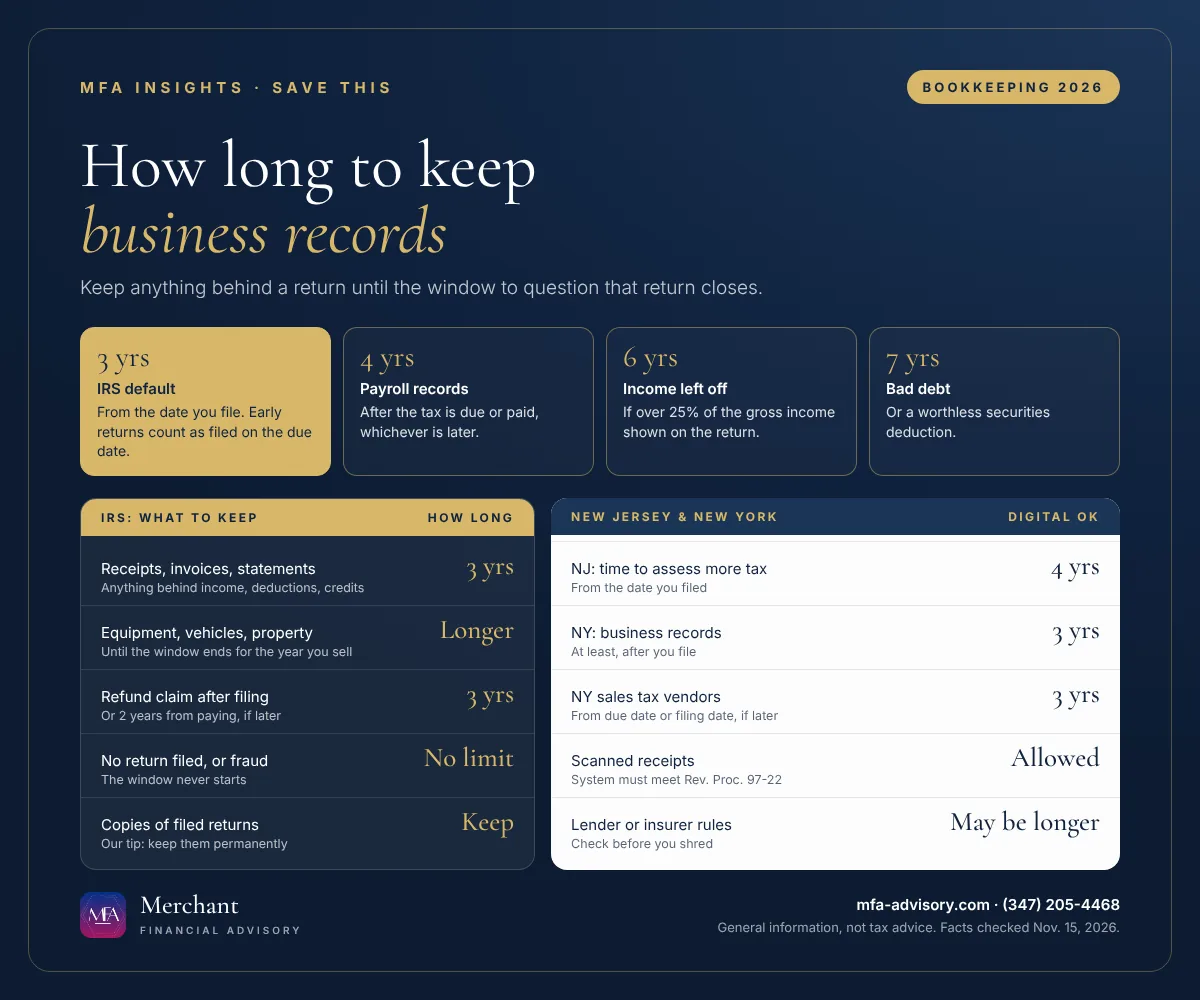
How long to keep business records: the IRS rules
When people ask how long to keep tax records, the IRS answer is tied to the period of limitations: the time it has to assess more tax, or you have to claim a refund. Each period runs from the date you filed the return.
| Situation | Keep records for |
|---|---|
| Most returns (no exception below) | 3 years |
| You claim a refund after filing | 3 years from filing or 2 years from paying, whichever is later |
| Income left off the return over 25% of the gross income shown | 6 years |
| Bad debt or worthless securities deduction | 7 years |
| No return filed, or a fraudulent return | Indefinitely |
Example: a 2025 return filed on April 15, 2026 is generally open to IRS changes for three years from that date, into April 2029. Keep the bank statements, invoices and receipts behind it at least that long.
How long to keep payroll records
If you have employees, keep employment tax records for at least four years after the tax is due or paid, whichever is later. That includes your payroll reports, payroll tax returns and tax deposit records. IRS Publication 15 lists the full set.
Asset records: keep them until you sell
Keep the purchase invoice, closing statement and depreciation records for equipment, vehicles and property until the period of limitations ends for the year you sell or dispose of the asset. You need them to figure depreciation and your gain or loss. A machine bought in 2020 and sold in 2028 means keeping its records into the 2030s.
How long to keep receipts for taxes
The IRS says to keep receipts, canceled checks and other documents that support the income, deductions and credits on your return. IRS Publication 583 lists the usual ones: cash register tapes, deposit slips, invoices, Forms 1099-NEC and 1099-MISC, account statements, credit card slips and petty cash slips. Our small business write-offs guide covers the proof each deduction needs.
How long to keep tax records in NJ and New York
- New Jersey: the Division of Taxation generally has four years from the date you filed to assess more tax, one year longer than the IRS. If you file in New Jersey, four years is the safer minimum for your business records.
- New York: the Tax Department says to keep records and supporting documents for at least three years after you file. For NY sales tax record keeping, vendors must keep sales and purchase records for at least three years from the return's due date or filing date, whichever is later, and longer if the department asks, for example during an audit.
Can I keep digital copies of receipts?
Yes. The IRS applies the same rules to electronic records as to paper, and you may destroy the paper originals once your electronic storage system has been tested and meets the requirements in Revenue Procedure 97-22. In practice that means clear, complete scans you can find and print. New York lets sales tax vendors keep electronic records too, as long as they can be provided in a readable electronic form.
FAQs
Generally three years after you file for federal purposes, four years for payroll records, and longer for asset records or if income was left off a return. In New Jersey, plan on at least four years.
Yes. The IRS recommends keeping copies of filed returns, because they help you prepare future returns and amend past ones. We suggest keeping them permanently.
Check first whether a lender, insurer or other party needs them longer. The IRS notes that other parties can require records beyond the tax period.
Missing statements or a box of loose receipts? Merchant Financial Advisory (MFA), an accounting, tax and business solutions provider in Princeton, New Jersey, catches up and organizes the books for small and mid-sized businesses in New Jersey, New York and nationwide. See our bookkeeping services or catch-up bookkeeping cleanup, read our month-end close checklist, or book a call.
Save the key dates
- Thu, Dec 31, 2026Year-end: save and back up your 2026 books Download 2026 bank and card statements, payroll reports and receipts into one folder before you start the 2026 return. These records start their retention clock when you file.
Add to calendar
- Thu, Apr 15, 2027Tax Day: 2026 Form 1040 and Form 1120 due; your records clock starts The IRS three-year window for a 2026 return runs from the date you file it; a return filed early counts as filed on the due date. In New Jersey the window is generally four years.
Add to calendar
Subscribe to every MFA key date
"Add all these dates" downloads one file that opens in Apple Calendar, Outlook or Google Calendar (in Google, use Settings, then Import). Subscribing works with Apple, Google and Outlook and updates itself whenever we publish a new deadline.
Get key tax dates and new articles by email
Every new MFA Insights article, the IRS, New Jersey and New York deadlines that matter, and a calendar you can save. For individuals and small and mid-sized businesses.
Almost done: check your inbox and click the confirmation link to join MFA Insights. (If you don't see it in a minute, check Promotions or Spam.)
Have a question about this?
Ask us privately. Your question goes straight to our inbox, not onto the page, and we reply by email within one business day. Please don't include Social Security or account numbers.
Thanks, your question is in. We'll reply by email within one business day.
Sources
- IRS: How long should I keep records? (reviewed June 30, 2026)
- IRS: Topic no. 305, Recordkeeping (reviewed Oct. 13, 2026)
- IRS Publication 583 (12/2024), Starting a Business and Keeping Records
- IRS: When to file (reviewed Nov. 13, 2026)
- NJ Division of Taxation: Publication ANJ-1, New Jersey Taxpayers' Bill of Rights
- NY Department of Taxation and Finance: Recordkeeping (updated June 29, 2026)
- NY Department of Taxation and Finance: TB-ST-770, Recordkeeping requirements for sales tax vendors
Facts checked against the sources above as of November 15, 2026. This article is general information, not tax, legal, or financial advice, and reading it does not create a client relationship. Tax rules change and every situation is different; confirm the details for your situation with a qualified professional before acting.