
Executive summary
- 8 steps, same order every month: record, categorize, reconcile, review what's owed, adjust, tie out taxes, review reports, lock the month.
- Reconcile every bank and card account. The IRS recordkeeping guide says your bank statement, your checkbook and your books should agree.
- Lock the month in QuickBooks Online with a closing date, so nobody changes a closed period by accident.
- Year-end dates ride on clean books: NJ ST-50 for October to December is due Jan. 20, 2027, and 1099-NECs for 2026 payments of $2,000 or more are due Feb. 1, 2027.
Bottom line: Close November in the first half of December, and December becomes the easy part of year-end.
A month-end close checklist for small business is a short routine you run after each month ends: get every transaction in, prove it against the bank, adjust what belongs in the month, review the reports and lock the period. Do it monthly and tax time is a review, not a rescue. Skip it and small errors pile up until January. Closing monthly books also keeps your sales tax returns and estimated tax payments based on real numbers.
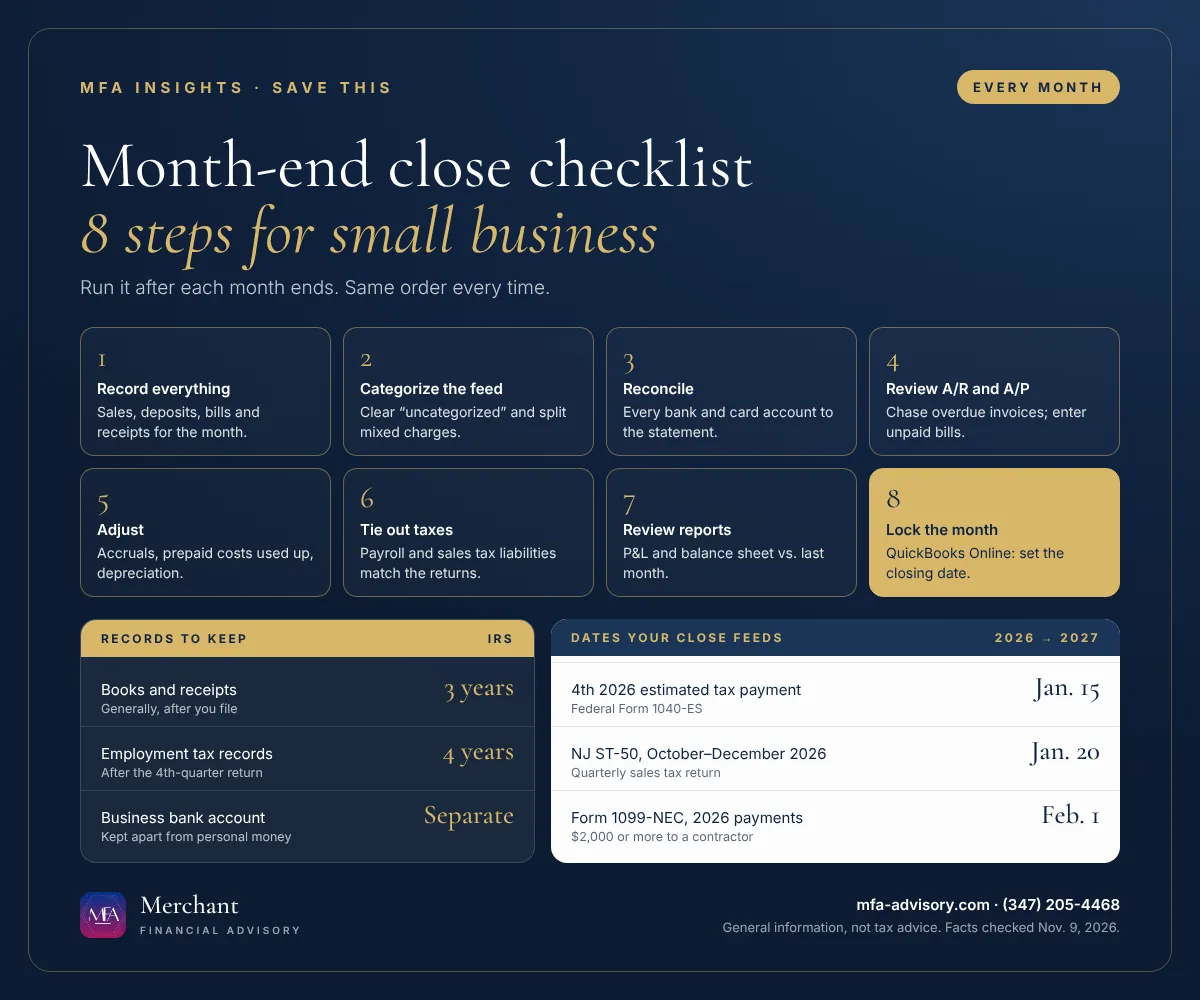
How to close your books each month: the 8-step checklist
- Record everything. Enter sales, deposits, bills and receipts for the month. The IRS calls these supporting documents: sales slips, paid bills, invoices, receipts, deposit slips and canceled checks.
- Categorize the bank feed. Clear anything sitting in "uncategorized" or a suspense account, and split mixed charges.
- Reconcile every bank and credit card account to the month-end statement (more below).
- Review who owes you and whom you owe. Follow up on overdue invoices and enter bills you received but haven't paid.
- Record accruals and adjustments. On accrual books: expenses incurred but not yet billed, income earned but not yet invoiced, prepaid costs used up, and depreciation.
- Tie out payroll and sales tax. The balances in your payroll and sales tax liability accounts should match the payroll reports and the returns you file.
- Review the reports. Compare this month's profit and loss and balance sheet with last month. Ask about any swing you can't explain.
- Lock the month and save the reports with the bank statements.
Bank reconciliation for small business: the step people skip
A reconciliation proves your books match the bank. IRS Publication 583 puts it simply: when your statement arrives, make sure the statement, your checkbook and your books agree. Compare the deposits on the statement with the deposits you recorded, compare each check by number and amount, then update your books for anything the bank shows that you hadn't recorded, such as fees or interest.
Two habits make this faster. Keep business money in a separate business account, as the IRS recommends, and reconcile credit cards too, since that is where personal charges tend to slip in.
Cash or accrual: does the close change?
Under the cash method, you report income in the year you receive it. Under an accrual method, you generally report income in the year you earn it. Step 5 matters most on accrual books, because that's where you record what was earned or owed in the month even if no money moved. On cash books the close is shorter, but steps 1 to 4 and 6 to 8 still apply.
How to close the books in QuickBooks Online
Locking the month stops anyone from changing a period you've already reviewed. Intuit's steps:
- Select the Settings gear, then Account and settings.
- Open the Advanced tab and select Edit in the Accounting section.
- Turn on Close the books and enter the closing date (the last day of the month you closed).
- Pick a security option. "Allow changes after viewing a warning and entering password" adds a password check.
- Select Save.
Move the closing date forward each month once the close is done. Our QuickBooks Online chart of accounts packs help if your categories need a cleanup first.
Month-end close in New Jersey and New York: sales tax and payroll
- New Jersey: every seller files a quarterly ST-50 by the 20th of the month after the quarter; the October to December 2026 return is due January 20, 2027. Businesses that collected more than $30,000 in sales tax in the prior year also make monthly payments. See our ST-50 filing guide.
- New York: sales tax quarters don't follow the calendar. The first quarter of the sales tax year ran March 1 to May 31, 2026, and its return was due June 22, 2026. Check the period on each return before you match it to your books.
- Payroll, both states: keep employment tax records for at least four years after you file the fourth-quarter return for the year.
What does a bookkeeper do for a small business?
Mostly this checklist, every month, on time. A good bookkeeper also keeps the 1099 records clean during the year, so January filing is quick. That matters for 2026: Form 1099-NEC goes to contractors you paid $2,000 or more, and it's due February 1, 2027. Our 1099 preparation guide walks through it.
FAQs
Keep records for as long as they support a return, generally at least 3 years after you file. Keep employment tax records at least 4 years after filing the fourth-quarter return.
It isn't a legal requirement, but a monthly close keeps your estimated tax payments accurate and makes your Schedule C a short job instead of a year of catch-up.
Yes, if your security setting allows it. With the password option, QuickBooks shows a warning and asks for the closing date password before saving a change to a closed period.
Start with the oldest open month and work forward, reconciling each bank and card account as you go. If it's more than a few months, a catch-up cleanup is usually faster than doing it piecemeal.
Merchant Financial Advisory (MFA), an accounting, tax and business solutions provider in Princeton, New Jersey, closes the books each month for small and mid-sized businesses in New Jersey, New York and nationwide. See our bookkeeping services or catch-up bookkeeping cleanup, grab the Month-End Close Checklist below, or book a call.
Save the key dates
- Fri, Jan 15, 2027Fourth 2026 estimated tax payment due (federal 1040-ES) You can skip it if you file your 2026 return and pay the entire balance by Feb. 1, 2027. A closed December makes the number easy to figure.
Add to calendar
- Wed, Jan 20, 2027NJ: ST-50 sales tax return due for October to December 2026 Quarterly return for all New Jersey sales tax filers. Reconcile sales tax collected in your books to the return.
Add to calendar
- Mon, Feb 1, 2027Form 1099-NEC due to contractors and the IRS (2026 payments) For nonemployee pay of $2,000 or more in 2026. January 31, 2027 is a Sunday, so the due date moves to Monday, February 1.
Add to calendar
Subscribe to every MFA key date
"Add all these dates" downloads one file that opens in Apple Calendar, Outlook or Google Calendar (in Google, use Settings, then Import). Subscribing works with Apple, Google and Outlook and updates itself whenever we publish a new deadline.
Get key tax dates and new articles by email
Every new MFA Insights article, the IRS, New Jersey and New York deadlines that matter, and a calendar you can save. For individuals and small and mid-sized businesses.
Almost done: check your inbox and click the confirmation link to join MFA Insights. (If you don't see it in a minute, check Promotions or Spam.)
Have a question about this?
Ask us privately. Your question goes straight to our inbox, not onto the page, and we reply by email within one business day. Please don't include Social Security or account numbers.
Thanks, your question is in. We'll reply by email within one business day.
Sources
- IRS Publication 583: Starting a Business and Keeping Records
- IRS: Employment tax recordkeeping
- IRS: 2026 Instructions for Forms 1099-MISC and 1099-NEC
- IRS: 2026 Form 1040-ES, Estimated Tax for Individuals
- NJ Division of Taxation: Sales and Use Tax filing chart
- NY Department of Taxation and Finance: Quarterly filer forms (ST-100 series)
- QuickBooks Online Help: Close your books
Facts checked against the sources above as of November 9, 2026. This article is general information, not tax, legal, or financial advice, and reading it does not create a client relationship. Tax rules change and every situation is different; confirm the details for your situation with a qualified professional before acting.