
Executive summary
- The form: a foreign individual gives you Form W-8BEN; a foreign company gives you Form W-8BEN-E. A W-9 is only for US persons, including US citizens who live abroad.
- Work done entirely abroad: pay to a foreign contractor for services performed outside the US is generally foreign-source income, so there's generally no 1099-NEC, no 30% withholding and no Form 1042-S.
- The deduction: payments to overseas contractors are deductible as contract labor like any other business expense, as long as you can prove them.
- The savings: come from the lower cost, not from a special tax break. The deduction works the same whether you pay someone in Ohio or overseas.
Bottom line: Collect the right W-8 (or W-9) before the first payment, keep a contract and invoices that show where the work was done, and book the payments as contract labor.
More small businesses are hiring overseas contractors to cut costs: a bookkeeper in Pakistan, a developer in India, a virtual assistant in the Philippines. The first tax question is almost always "What W-9 do I need?" Usually the answer is not a W-9 at all. This guide covers the form to collect, when a 1099 or withholding applies, how the deduction works and the records that back it up.
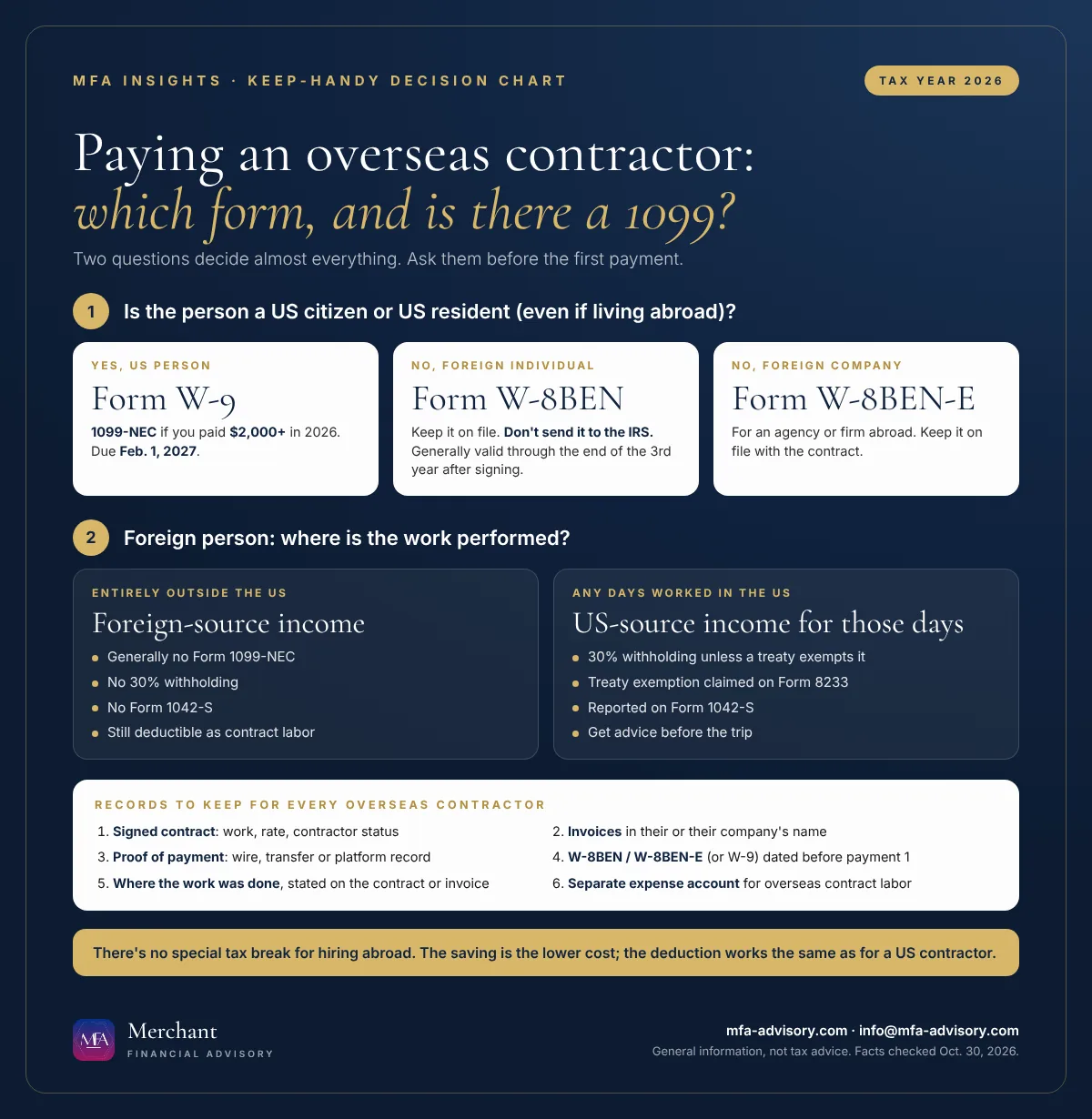
W-8BEN vs. W-9: which form do I collect from an overseas contractor?
The form depends on the person's tax status, not where they live.
| Who you're paying | Form to collect | What it does |
|---|---|---|
| A foreign individual (a nonresident alien) | Form W-8BEN | Certifies the person is foreign |
| A foreign company or agency | Form W-8BEN-E | Certifies the entity is foreign and states its status |
| A US citizen or US resident, even one living abroad | Form W-9 | Gives you their US taxpayer ID for a 1099 |
A few points straight from the IRS instructions:
- You keep the form. Don't send it to the IRS. The contractor gives it to you, the payer.
- US citizens and residents never use a W-8BEN. The W-8BEN instructions tell them to use Form W-9 instead.
- A W-8BEN generally stays valid until the last day of the third calendar year after the year it's signed, so a form signed in 2026 generally runs through Dec. 31, 2029. The contractor must tell you within 30 days if something changes, such as a move to the US.
- Ask for it before the first payment. The instructions say to submit the form when the payer requests it, even when no treaty benefit is claimed. It's your proof of why you didn't issue a 1099.
Do I issue a 1099 to a foreign contractor?
Generally not, when all the work happens outside the US. Here's why.
The source rule: where the work is performed
The IRS says a nonresident alien is generally taxed in the US only on US-source income, and for personal services the source is where the services are performed. That's true regardless of where the contract was signed, where the payment comes from or where the payer lives. So a developer in Lahore working on your app from Lahore is earning foreign-source income, even though a New Jersey business pays the invoice.
Applied to the information returns:
- No 1099-NEC. The IRS 1099 instructions send payments to nonresident aliens to Form 1042-S instead, and that form only covers US-source income (see below).
- No 30% withholding. The 30% withholding in IRS Publication 515 applies to US-source income paid to foreign persons.
- No Form 1042-S. Form 1042-S reports a foreign person's US-source income subject to withholding, so pay for work done abroad generally doesn't go on it. The IRS says the same about wages: pay that nonresident aliens earn for services performed outside the US is foreign-source income and isn't subject to US reporting and withholding.
When the answer changes
- The contractor works while in the US. Pay for days worked in the US is US-source income. It's generally subject to 30% withholding unless a tax treaty exempts it (claimed on Form 8233, not the W-8BEN) and is reported on Form 1042-S. If work is split between countries, the IRS generally allocates pay by the number of days worked in each.
- The contractor is a US citizen or green card holder living abroad. Collect a W-9 and file a Form 1099-NEC if you paid them $2,000 or more for 2026. It's due Feb. 1, 2027. Our Form 1099 guide for 2026 covers the details.
Can I deduct payments to overseas contractors?
Yes. Payments for work that is ordinary and necessary for your business are deductible wherever the contractor lives. On Schedule C they go on line 11, contract labor, which the IRS describes as payments to people you don't treat as employees, such as independent contractors. Corporations and partnerships deduct them on their own returns the same way.
What makes the deduction stick is documentation. The IRS says your records should show the payee, the amount, proof of payment, the date and a description showing the business purpose. For an overseas contractor, keep:
- A signed contract that describes the work, the rate and that the person is an independent contractor.
- Invoices for each payment, in their name or their company's name.
- Proof of payment: bank wire, transfer confirmation or platform statement.
- The W-8BEN or W-8BEN-E (or the W-9 for a US person), dated before the first payment.
- Where the work was performed. A line in the contract or on each invoice ("All services performed in Pakistan") supports the foreign-source treatment.
In your books, give overseas contract labor its own expense account or class so it's easy to separate from US contractors at 1099 time. Our small business write-offs guide for 2026 covers the proof rules for other expenses.
What does hiring overseas actually save? An illustrative example
The example below is illustrative only. The salary, contractor rate and tax rate are assumptions, not market data or a promise of savings.
| US employee (assumed) | Overseas contractor (assumed) | |
|---|---|---|
| Annual pay | $55,000 salary | $18,000 ($1,500 a month) |
| Employer Social Security and Medicare (7.65%) | $4,207.50 | None |
| Pre-tax cost (before benefits, unemployment tax, equipment) | $59,207.50 | $18,000 |
| After-tax cost at an assumed 25% tax rate | About $44,406 | About $13,500 |
Two things to notice. First, both costs are deductible, so the tax rate shrinks both by the same 25%. The saving comes from the lower price, not from a tax break. Second, the 7.65% employer share of Social Security (6.2%) and Medicare (1.45%) applies to employees, not to independent contractors. Real savings also depend on platform and transfer fees, time zones, review time and the quality of the work.
Contractor or employee? It still matters overseas
The IRS uses the common-law test, which looks at behavioral control, financial control and the relationship of the parties. If you set the hours, supply the tools and direct how the work is done, the person may look more like an employee than a contractor.
- US self-employment tax: the IRS says it generally doesn't apply to someone who is neither a US citizen nor a US resident (unless a totalization agreement says otherwise), so your overseas contractor isn't paying US self-employment tax on this income.
- Local law: the worker's own country has its own tax and employment rules, and those can treat a long-term, full-time arrangement as employment. Check them before you treat someone as full-time staff.
Payment apps, Form 1099-K and FBAR: what doesn't apply
- Payment platforms: the IRS 1099 instructions say payments made by credit card or through third-party payment networks are reported on Form 1099-K by the payment company, not on a 1099-NEC by you. That mainly matters for US contractors you pay through those platforms.
- FBAR: the FBAR is filed by a US person with a financial interest in, or signature authority over, foreign accounts worth more than $10,000 in total. Sending money to a contractor's foreign bank account doesn't make it your account, so paying someone doesn't by itself require an FBAR.
Quick checklist before the first overseas payment
- Confirm whether the person is a US citizen or resident (W-9) or foreign (W-8BEN or W-8BEN-E).
- Sign a contractor agreement that states where the work will be performed.
- Set up a separate expense account for overseas contract labor.
- Save every invoice with its proof of payment.
- Calendar a reminder to refresh each W-8BEN before it expires, and ask contractors to tell you if they travel to the US to work.
FAQs
Not if they're foreign. A foreign individual gives you Form W-8BEN and a foreign company gives you Form W-8BEN-E. Only US citizens and residents, including those living abroad, give a W-9.
Generally no, if the person is foreign and performs all the work outside the US. That pay is foreign-source income, so it generally isn't reported on Form 1099-NEC or Form 1042-S and isn't subject to 30% withholding.
Yes, when the work is ordinary and necessary for your business and you keep the contract, invoices and proof of payment. Sole proprietors report them on Schedule C line 11 as contract labor.
Pay for work done in the US is US-source income. It's generally subject to 30% withholding unless a treaty exemption applies through Form 8233, and is reported on Form 1042-S. Get advice before the trip.
Generally until the last day of the third calendar year after the year it was signed, unless the person's circumstances change. A form signed in 2026 generally stays valid through Dec. 31, 2029.
No. The payments are deductible the same way US contractor payments are. Any saving comes from the lower cost of the work.
Merchant Financial Advisory (MFA), an accounting and tax solutions provider in Princeton, New Jersey, helps individuals and small and mid-sized businesses in New Jersey, New York and nationwide set up contractor onboarding, keep clean books and file information returns correctly. See our 1099 filing service, or book a consultation.
Save the key dates
- Mon, Feb 1, 2027Form 1099-NEC due for US contractors, including US citizens living abroad For 2026 payments of $2,000 or more for services to a contractor who gave you a Form W-9. January 31, 2027 is a Sunday, so the due date moves to Monday, February 1. Overseas contractors on a W-8BEN who did all the work abroad generally don't get one.
Add to calendar
Subscribe to every MFA key date
"Add all these dates" downloads one file that opens in Apple Calendar, Outlook or Google Calendar (in Google, use Settings, then Import). Subscribing works with Apple, Google and Outlook and updates itself whenever we publish a new deadline.
Get key tax dates and new articles by email
Every new MFA Insights article, the IRS, New Jersey and New York deadlines that matter, and a calendar you can save. For individuals and small and mid-sized businesses.
Almost done: check your inbox and click the confirmation link to join MFA Insights. (If you don't see it in a minute, check Promotions or Spam.)
Have a question about this?
Ask us privately. Your question goes straight to our inbox, not onto the page, and we reply by email within one business day. Please don't include Social Security or account numbers.
Thanks, your question is in. We'll reply by email within one business day.
Sources
- IRS: Instructions for Form W-8BEN (Rev. October 2021)
- IRS: Instructions for Form W-8BEN-E (Rev. October 2021)
- IRS: About Form W-8BEN
- IRS: Nonresident aliens, sourcing of income
- IRS: Source of income, personal service income
- IRS: Persons employed abroad by a U.S. person
- IRS Publication 515 (2026): Withholding of Tax on Nonresident Aliens and Foreign Entities
- IRS: Instructions for Forms 1099-MISC and 1099-NEC (Rev. December 2026)
- IRS: Instructions for Schedule C (Form 1040) (2025)
- IRS: Self-employment tax (international taxpayers)
- IRS Topic No. 762: Independent contractor vs. employee
- IRS Topic No. 751: Social Security and Medicare withholding rates
- IRS: Report of Foreign Bank and Financial Accounts (FBAR)
- IRS: What kind of records should I keep?
Facts checked against the sources above as of October 30, 2026. This article is general information, not tax, legal, or financial advice, and reading it does not create a client relationship. Tax rules change and every situation is different; confirm the details for your situation with a qualified professional before acting.