
Executive summary
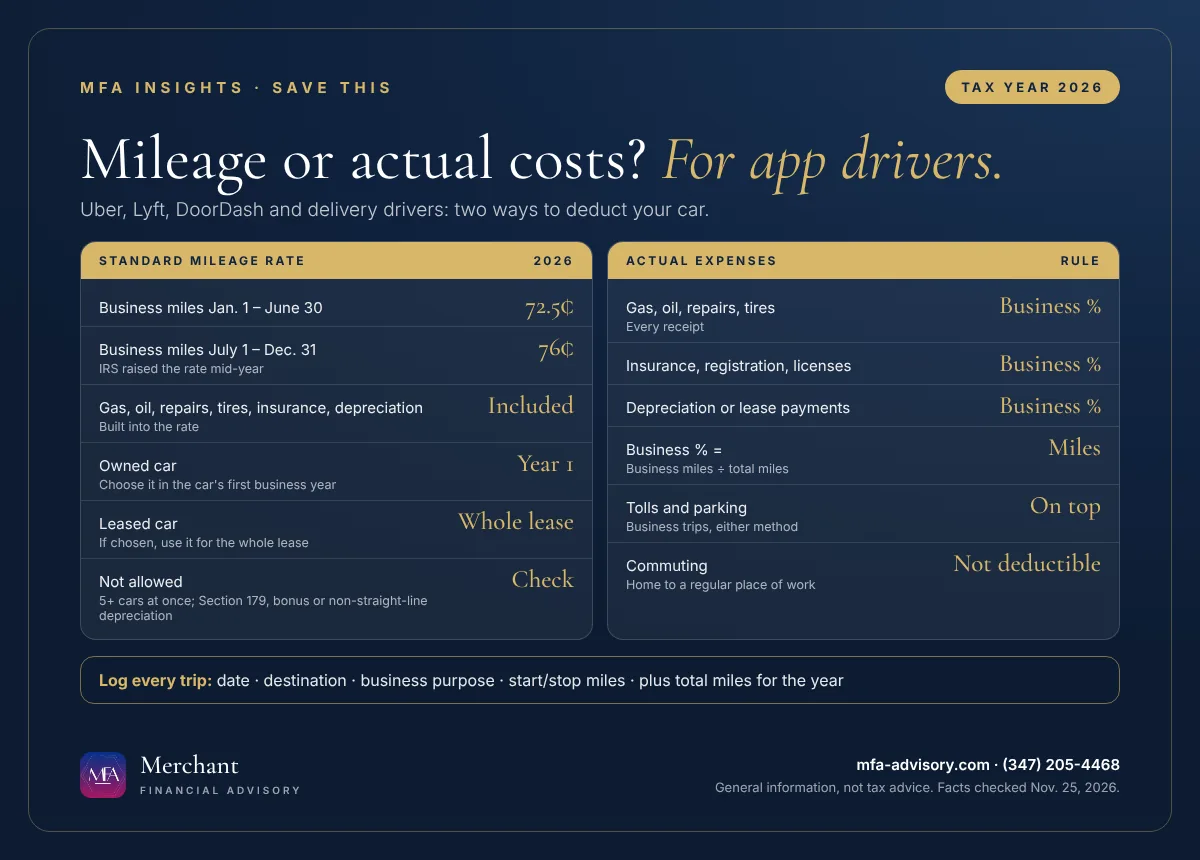
- 2026 has two mileage rates: 72.5¢ a mile for business miles from Jan. 1 to June 30, and 76¢ a mile from July 1 to Dec. 31.
- Actual expenses means the business share of gas, repairs, tires, insurance, registration and depreciation or lease payments, split by miles.
- The first year decides: to use the standard rate on a car you own, you must choose it in the car's first business year. On a leased car, it's for the whole lease.
- Tolls and parking for business trips are deducted on top under either method.
Bottom line: Keep a trip-by-trip mileage log and every car receipt for 2026, then run both methods before you file.
For Uber, Lyft and DoorDash taxes, you can deduct your car with the standard mileage rate or with actual expenses. For 2026 the standard rate is 72.5¢ a mile through June 30 and 76¢ a mile from July 1. Actual expenses win more often for costly cars with fewer miles. Either way, you need a mileage log.
What is the standard mileage rate for 2026 for rideshare drivers?
The IRS set two business rates for 2026. It raised the rate in the middle of the year (Announcement 2026-11, effective July 1, 2026).
| Business miles driven | Rate per mile |
|---|---|
| Jan. 1 – June 30, 2026 | 72.5¢ |
| July 1 – Dec. 31, 2026 | 76¢ |
| For comparison: all of 2025 | 70¢ |
Because of the split, your log has to show when each mile was driven. A single yearly total isn't enough to apply the right rate.
The rate already covers gas, oil, repairs, tires, insurance and depreciation. You don't deduct those separately.
Can DoorDash drivers deduct actual car expenses instead?
Yes. With actual expenses, you add up what the car really cost and deduct the business share.
The IRS list includes gas, oil, repairs, tires, insurance, registration fees, licenses, and depreciation or lease payments.
The business share comes from your miles. If 80% of the miles you drove were for the apps, you deduct 80% of the costs.
Driving between your home and a regular place of work is commuting, which isn't deductible. Your log should show what each trip was for.
Mileage vs actual expenses: which saves an Uber driver more?
Two made-up 2026 drivers show how it plays out. Both own their cars, chose their method in the car's first business year and drove half their business miles before July 1.
| Example driver | Miles and costs | Standard mileage | Actual expenses |
|---|---|---|---|
| Full-time Uber | 20,000 business miles of 25,000 (80%); car costs $12,000 | 10,000 × 72.5¢ + 10,000 × 76¢ = $14,850 | $12,000 × 80% = $9,600 |
| Part-time DoorDash, newer SUV | 6,000 business miles of 12,000 (50%); car costs $16,000 | 3,000 × 72.5¢ + 3,000 × 76¢ = $4,455 | $16,000 × 50% = $8,000 |
High miles in an efficient car usually favor the standard rate. A pricey car with fewer miles often favors actual costs.
Check your own numbers with our mileage deduction calculator.
Can I switch from actual expenses to standard mileage?
Only if you started with the standard rate. To use it on a car you own, you must choose it in the first year the car is used in your business. After that, you can pick either method each year.
If you start with actual expenses, the standard rate is off the table for that car. On a leased car, choosing the standard rate means using it for the entire lease, including renewals.
You also can't use the standard rate if you run five or more cars at the same time, or if the car was depreciated with Section 179, bonus depreciation or any method other than straight-line.
Are tolls and parking deductible for rideshare drivers?
Yes. Parking fees and tolls for business trips are deducted separately under either method. Keep the receipts or the toll account statements.
What mileage log do Uber drivers need?
The IRS lists what proves a car expense. For each business use, write down:
- the date
- where you drove
- the business purpose
- the miles, from start and stop readings
You also need your total miles for the year, so note your odometer on Dec. 31. Keep these records for at least 3 years from the date you file the return.
Do Uber drivers get a 1099-K?
It depends on how you're paid. A third-party payment platform only has to file a 1099-K when your payments top $20,000 and 200 transactions. Card payments have no threshold, and some states set lower limits.
Either way, all of it is taxable. The IRS says income is taxable even if you don't get a Form 1099-K. Use your app's yearly tax summary and your bank deposits.
Your driving income and car deduction go on Schedule C. This post covers the federal rules; ask us about your New Jersey or New York return.
FAQs
72.5¢ a mile for business miles from Jan. 1 to June 30, 2026, and 76¢ a mile from July 1 to Dec. 31, 2026.
No. Gas, oil, repairs, tires, insurance and depreciation are built into the rate. Tolls and parking for business trips are still deducted on top.
Yes, but if you choose it, you must use it for the entire lease period, including renewals.
It depends on your facts. Commuting between home and a regular place of work isn't deductible, so log the purpose of every trip and ask us how your driving pattern is treated.
Yes. All income is taxable unless the law says otherwise, even without a Form 1099-K.
Merchant Financial Advisory (MFA), an accounting, tax and business solutions provider in Princeton, New Jersey, prepares returns for Uber, Lyft and delivery drivers in New Jersey, New York and nationwide. Read our Schedule C guide and our 2026 small business write-offs guide, then see rideshare driver taxes with MFA.
Save the key dates
- Thu, Dec 31, 2026Drivers: write down your Dec. 31 odometer reading Your 2026 records need total miles for the year as well as business miles, so note the odometer at year-end.
Add to calendar
Subscribe to every MFA key date
"Add all these dates" downloads one file that opens in Apple Calendar, Outlook or Google Calendar (in Google, use Settings, then Import). Subscribing works with Apple, Google and Outlook and updates itself whenever we publish a new deadline.
Get key tax dates and new articles by email
Every new MFA Insights article, the IRS, New Jersey and New York deadlines that matter, and a calendar you can save. For individuals and small and mid-sized businesses.
Almost done: check your inbox and click the confirmation link to join MFA Insights. (If you don't see it in a minute, check Promotions or Spam.)
Have a question about this?
Ask us privately. Your question goes straight to our inbox, not onto the page, and we reply by email within one business day. Please don't include Social Security or account numbers.
Thanks, your question is in. We'll reply by email within one business day.
Sources
- IRS: Standard mileage rates
- IRS: Internal Revenue Bulletin 2026-29 (Announcement 2026-11, revised rates from July 1, 2026)
- IRS: Topic no. 510, Business use of car
- IRS: Publication 463, Travel, Gift, and Car Expenses
- IRS: Form 1099-K FAQs, general information
Facts checked against the sources above as of November 25, 2026. This article is general information, not tax, legal, or financial advice, and reading it does not create a client relationship. Tax rules change and every situation is different; confirm the details for your situation with a qualified professional before acting.