
The short version
- $192,300 in 2027: the most earnings that Social Security tax applies to, up from $184,500 in 2026.
- Self-employed: you pay 12.4% Social Security tax up to the cap and 2.9% Medicare tax on everything, on 92.35% of your net profit.
- Up to $967.20 more: the most the higher cap adds to one person's 2027 Social Security tax ($7,800 × 12.4%).
- Who feels it: net profit above about $199,800, or a W-2 job plus a business that together pass $184,500.
Bottom line: If your earnings were near or above the cap in 2026, add up to $967.20 to your 2027 tax estimate. Everyone below the cap pays the same rate as before.
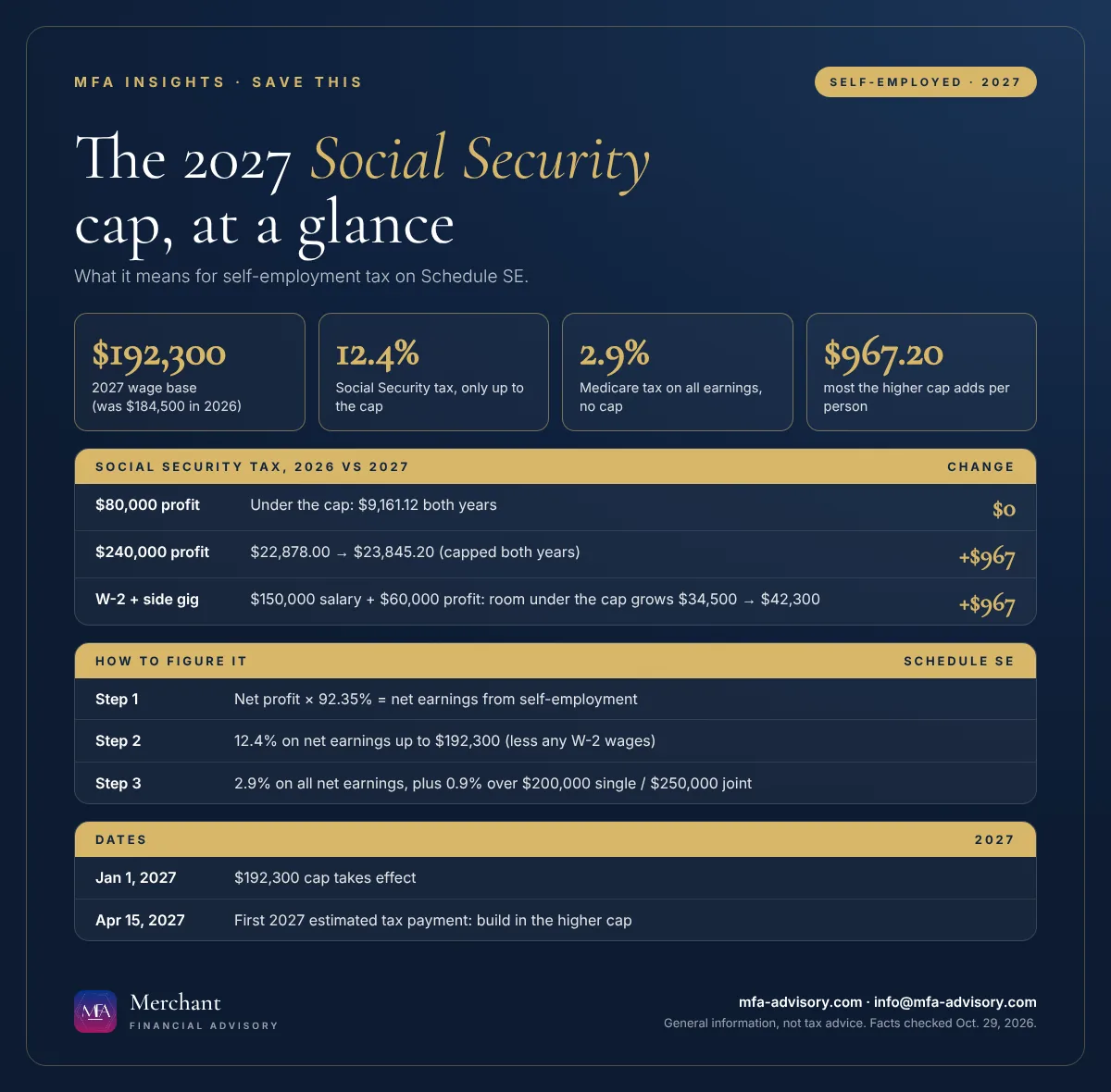
The 2027 Social Security wage base is $192,300. The wage base is the yearly cap on earnings that Social Security tax applies to. The Social Security Administration announced it in October 2026 along with a 3.6% benefit increase, and it takes effect on Jan. 1, 2027. Employees see it on their paychecks. If you work for yourself, it shows up in your self-employment tax on Schedule SE.
What is the Social Security wage base for 2027?
| Figure | 2026 | 2027 |
|---|---|---|
| Social Security wage base (maximum taxable earnings) | $184,500 | $192,300 |
| Medicare earnings cap | None | None |
| Self-employment tax rate (Social Security + Medicare) | 15.3% | 15.3% |
| Most Social Security tax a self-employed person pays | $22,878.00 | $23,845.20 |
| Earnings for one Social Security credit (quarter of coverage) | $1,890 | $1,970 |
The rates don't change. Only the cap moves, so the extra tax falls on earnings between $184,500 and $192,300.
How self-employment tax works with the wage base
Self-employment tax is the Social Security and Medicare tax people who work for themselves pay, covering both the employee and employer shares. You figure it on Schedule SE:
- Take your net profit (Schedule C, or your share from a partnership).
- Multiply by 92.35%. That's your net earnings from self-employment.
- Pay 12.4% Social Security tax on those earnings, up to $192,300 in 2027.
- Pay 2.9% Medicare tax on all of them. There's no cap. An extra 0.9% Additional Medicare Tax applies to earnings over $200,000 single or $250,000 married filing jointly.
You can deduct half of your self-employment tax on Form 1040, so the higher cap also raises that deduction a little. You owe self-employment tax once net earnings reach $400.
Who pays more Social Security tax in 2027?
Three examples, using 2027 figures against 2026:
| Situation | 2026 Social Security tax | 2027 Social Security tax | Change |
|---|---|---|---|
| Freelancer, $80,000 net profit ($73,880 net earnings) | $9,161.12 | $9,161.12 | $0 |
| Consultant, $240,000 net profit ($221,640 net earnings) | $22,878.00 | $23,845.20 | +$967.20 |
| $150,000 W-2 salary plus $60,000 side-business profit ($55,410 net earnings) | $4,278.00 on the business | $5,245.20 on the business | +$967.20 |
The freelancer earning $80,000 is well under the cap, so nothing changes: 15.3% of $73,880, or $11,303.64 in total self-employment tax, either year. The consultant's Medicare tax ($6,427.56) is the same both years too. Only the Social Security part moves.
The W-2 plus side business case
If you have a job and a business, Social Security tax on your wages counts first. Your employer withholds it on your $150,000 salary, and only the room left under the cap applies to your business: $34,500 in 2026, $42,300 in 2027. People in this spot hit the cap sooner than they expect, and they also pay a bit more when the cap rises. Schedule SE does this math for you, but your estimated payments should reflect it.
What to do now
- Check your 2026 numbers. If your net earnings from self-employment, plus any W-2 wages, came close to $184,500, plan for up to $967.20 more Social Security tax in 2027.
- Update your 2027 estimates. The first 2027 payment is due April 15, 2027. Our quarterly estimated tax calculator and 1099 tax calculator show the effect.
- If you run an S corp: Social Security tax applies to the salary you pay yourself, not to distributions, so the cap matters only if your salary is near it. If you're a sole proprietor earning well into six figures, it may be worth asking whether an S corp election fits. See also our guide to an LLC taxed as an S corp.
- Collecting Social Security and still freelancing? The 2027 earnings test limit is $25,560 if you're under full retirement age all year ($1 of benefits withheld for every $2 over), and $67,920 in the year you reach it ($1 for every $3 over, counting months before that birthday).
FAQs
For a self-employed person, 12.4% of $192,300, or $23,845.20. An employee pays half of that, 6.2% or $11,922.60, and the employer pays the other half.
No. Medicare tax (2.9% for the self-employed) applies to all net earnings, with an extra 0.9% above $200,000 single or $250,000 married filing jointly.
Jan. 1, 2027. It applies to 2027 earnings, which you report on your 2027 return in 2028.
If two or more employers together withheld Social Security tax on more than the wage base, you claim the excess as a credit on your Form 1040.
$1,970 of earnings per credit, up to four credits a year ($7,880 for all four).
Save the key dates
- Fri, Jan 1, 20272027 Social Security wage base of $192,300 takes effect Social Security tax (12.4% for the self-employed) applies to net self-employment earnings and wages up to $192,300 in 2027. Medicare tax has no cap.
Add to calendar
- Thu, Apr 15, 2027First 2027 estimated tax payment due Build the higher Social Security cap into your 2027 Form 1040-ES estimates if your earnings are near $192,300.
Add to calendar
Subscribe to every MFA key date
"Add all these dates" downloads one file that opens in Apple Calendar, Outlook or Google Calendar (in Google, use Settings, then Import). Subscribing works with Apple, Google and Outlook and updates itself whenever we publish a new deadline.
Get key tax dates and new articles by email
Every new MFA Insights article, the IRS, New Jersey and New York deadlines that matter, and a calendar you can save. For individuals and small and mid-sized businesses.
Almost done: check your inbox and click the confirmation link to join MFA Insights. (If you don't see it in a minute, check Promotions or Spam.)
Have a question about this?
Ask us privately. Your question goes straight to our inbox, not onto the page, and we reply by email within one business day. Please don't include Social Security or account numbers.
Thanks, your question is in. We'll reply by email within one business day.
Sources
- Social Security Administration: 2027 Social Security Changes (fact sheet: $192,300 maximum taxable earnings, quarter of coverage, earnings test)
- IRS: Self-employment tax (Social Security and Medicare taxes)
- IRS: Questions and answers for the Additional Medicare Tax
- IRS: About Schedule SE (Form 1040), Self-Employment Tax
- IRS: About Form 1040-ES, Estimated Tax for Individuals
Facts checked against the sources above as of October 29, 2026. This article is general information, not tax, legal, or financial advice, and reading it does not create a client relationship. Tax rules change and every situation is different; confirm the details for your situation with a qualified professional before acting.