
Executive summary
- Repairs are deducted in the year you pay them; improvements are capitalized and, for residential rental property, depreciated over 27.5 years.
- An improvement betters, restores or adapts the property: fixing a pre-existing defect, enlarging it, replacing a major component or converting it to a new use.
- Three safe harbors let you deduct more: de minimis ($2,500 per invoice or item), small taxpayers (the lesser of $10,000 or 2% of a building's basis, for buildings of $1 million or less) and routine maintenance.
- Timing matters: pay by December 31, 2026 for a 2026 deduction, and attach the elections to your timely filed 2026 return.
Bottom line: Before year-end, sort this year's rental invoices into repairs and improvements, then check whether a safe harbor lets you deduct the improvements now.
Rental property repairs vs improvements is the question that decides whether a landlord's spending cuts this year's tax bill or gets spread over decades. The IRS rule is simple to state: you may deduct the cost of repairing or maintaining a rental, but you must capitalize any expense that improves it. Here's how to tell them apart, and the safe harbors that let small owners deduct more in 2026.
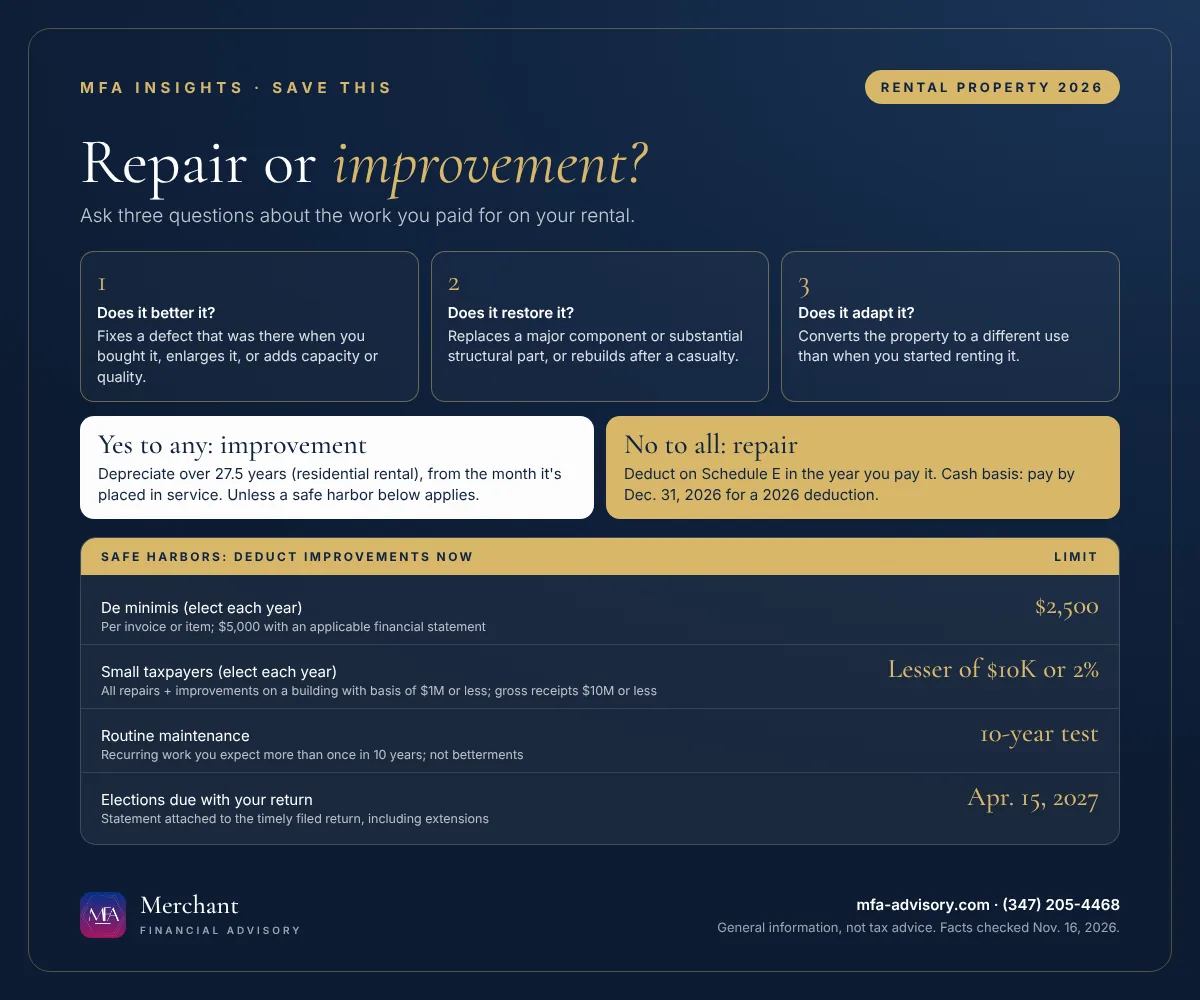
Repair or improvement on a rental property: the IRS test
Under the IRS tangible property regulations, work on a rental is an improvement only if it does one of three things:
| Test | What it means |
|---|---|
| Betterment | Fixes a defect that existed before you bought the property, enlarges or expands it, or materially increases its capacity, strength or quality |
| Restoration | Replaces a major component or substantial structural part, rebuilds after a casualty, or returns run-down property to working order |
| Adaptation | Converts the property to a use different from its use when you started renting it |
If none of these applies, the cost is generally a repair or maintenance expense you deduct on Schedule E. IRS Publication 527 lists typical improvements, including a new roof, a furnace, central air conditioning, a water heater, kitchen modernization, new flooring and added rooms or decks.
Can I deduct repairs on rental property in 2026?
Yes. Most landlords use the cash method, so you generally deduct rental expenses in the year you pay them. A repair paid on December 30, 2026 counts for 2026; one paid on January 4, 2027 counts for 2027. Keep separate records for repairs and improvements, as the IRS advises, because a mixed invoice is where most questions start.
Rental property depreciation: 27.5 years for improvements
An improvement to residential rental property is depreciated under the general system over 27.5 years, using the mid-month convention, so it's treated as placed in service in the middle of the month you finish it. Depreciation starts when the improvement is placed in service, meaning ready and available for use in the rental. Keep these records until you sell; our records retention guide explains why.
Three safe harbors that let you deduct more now
- De minimis safe harbor: deduct items costing up to $2,500 per invoice or item ($5,000 if you have an applicable financial statement, such as audited statements), such as a new refrigerator for a unit. You elect it each year with a statement on your timely filed return, including extensions.
- Safe harbor for small taxpayers: if your average annual gross receipts are $10 million or less and the building's unadjusted basis is $1 million or less, you can deduct all repairs, maintenance and improvements on that building when the year's total is no more than the lesser of $10,000 or 2% of its unadjusted basis. Go over the limit and you can't use it for that building that year. You elect it each year with a statement on your timely filed return.
- Routine maintenance safe harbor: recurring work to keep a building or its systems running, which you expect to do more than once in the 10 years after it's placed in service, isn't treated as an improvement. It doesn't cover betterments.
Example: a rental with an unadjusted basis of $300,000 has a small taxpayer limit of $6,000 (2% of $300,000 is less than $10,000). If your 2026 repairs and improvements on it total $5,500, you can elect to deduct all of it. At $6,500, the regular rules apply instead.
Rental property tax deductions in NJ and NY
- New York: your New York adjusted gross income starts from your federal adjusted gross income, so the repair and depreciation amounts on your federal Schedule E generally carry into Form IT-201, including for New York City residents.
- New Jersey: net income from rents is its own category of income, and New Jersey has its own depreciation rules (for example, a $25,000 Section 179 limit). If you expense rental assets federally, you may need the GIT-DEP adjustment worksheet.
FAQs
Generally an improvement. IRS Publication 527 lists a new roof as an improvement, and replacing a substantial structural part is a restoration. Patching a few shingles after a storm is more likely a repair.
The IRS treats them as separate elections, each made with its own statement for the year. Which combination helps depends on your invoices, so it's worth running the numbers before you file.
Fixing a past treatment can be a change in accounting method rather than an amended return. Talk to a tax professional before you change it.
Yes, but partnerships and S corporations make the small taxpayer election at the entity level, on the entity's own return.
Own one rental or a few? Merchant Financial Advisory (MFA), an accounting, tax and business solutions provider in Princeton, New Jersey, helps landlords in New Jersey, New York and nationwide sort repairs from improvements, make the safe harbor elections and keep depreciation schedules right. See our tax preparation services, read our Section 179 and bonus depreciation guide, or book a call.
Save the key dates
- Thu, Dec 31, 2026Last day to pay 2026 rental repairs and place improvements in service Cash-basis landlords generally deduct rental expenses in the year paid. Depreciation on an improvement starts when it is placed in service, so work finished after December 31 lands in 2027.
Add to calendar
- Thu, Apr 15, 20272026 Form 1040 with Schedule E due; attach safe harbor elections The de minimis and small taxpayer safe harbor elections are statements attached to your timely filed 2026 return. File Form 4868 by this date for an automatic six-month extension to file (not to pay).
Add to calendar
- Fri, Oct 15, 2027Extended 2026 Form 1040 due (if you filed Form 4868) Safe harbor election statements can go on the timely filed extended return.
Add to calendar
Subscribe to every MFA key date
"Add all these dates" downloads one file that opens in Apple Calendar, Outlook or Google Calendar (in Google, use Settings, then Import). Subscribing works with Apple, Google and Outlook and updates itself whenever we publish a new deadline.
Get key tax dates and new articles by email
Every new MFA Insights article, the IRS, New Jersey and New York deadlines that matter, and a calendar you can save. For individuals and small and mid-sized businesses.
Almost done: check your inbox and click the confirmation link to join MFA Insights. (If you don't see it in a minute, check Promotions or Spam.)
Have a question about this?
Ask us privately. Your question goes straight to our inbox, not onto the page, and we reply by email within one business day. Please don't include Social Security or account numbers.
Thanks, your question is in. We'll reply by email within one business day.
Sources
- IRS Publication 527 (2025), Residential Rental Property
- IRS: Tangible property final regulations (reviewed Aug. 4, 2026)
- 26 CFR 1.263(a)-3, Amounts paid to improve tangible property
- IRS: When to file (reviewed Nov. 13, 2026)
- NJ Division of Taxation: Form GIT-DEP, Depreciation Adjustment Worksheet
- NY Department of Taxation and Finance: Instructions for Form IT-201 (2025)
Facts checked against the sources above as of November 16, 2026. This article is general information, not tax, legal, or financial advice, and reading it does not create a client relationship. Tax rules change and every situation is different; confirm the details for your situation with a qualified professional before acting.