Executive summary
- Accuracy: the Taxpayer Advocate says taxpayers should not rely on AI-generated answers to complex tax questions, and cites a review that found two tax chatbots gave inaccurate or irrelevant answers up to 50% of the time.
- Responsibility: you are ultimately responsible for what's on your return, whoever or whatever helped prepare it.
- Privacy: a public chatbot is not the place for your Social Security number, bank details or full tax documents.
- Scams: the IRS's 2026 Dirty Dozen list includes AI-enabled phone calls that impersonate the IRS, and viral "tax hacks" that push people to file false returns.
Bottom line: Use AI to understand and organize, not to decide or file. Check every rule and number against irs.gov or a person who signs their work.
Is it safe to use AI to do my taxes? Partly. AI is a fast way to understand a form, build a document checklist or sort a pile of receipts. It is not a safe way to decide what goes on your return or to file it unchecked. Here's what the IRS and its Taxpayer Advocate say, the four risks that matter, and seven steps to use AI without regretting it.
AI tax advice accuracy: what does the IRS say?
Three IRS sources speak to it directly:
- The Taxpayer Advocate Service (an independent office inside the IRS) says AI "may not be able to provide accurate answers to your complex tax questions," that taxpayers should not rely on AI-generated responses to complex tax questions, and that taxpayers are ultimately responsible for the information on their returns. It advises reviewing everything, verifying calculations and getting help from qualified professionals if needed.
- The 2026 Dirty Dozen list (IR-2026-30) repeats that taxpayers should verify any calculations or information provided by artificial intelligence, in its warning about AI-enabled phone scams.
- Guidance for tax professionals (IRS Office of Professional Responsibility, June 2026) says practitioners cannot rely solely on AI, must carefully review anything it drafts, and must handle client data only in secure, enterprise-approved AI tools. We cover that in AI in accounting and tax: what the IRS says in 2026.
AI tax filing safety risks: the 4 that matter
| Risk | What goes wrong | What to do |
|---|---|---|
| Wrong answers | Confident answers built on old rules, the wrong state or the wrong tax year | Check each rule on irs.gov or your state's tax site |
| Wrong numbers | Math or carry-over errors on income, deductions or credits | Recalculate from your actual forms |
| Privacy | Personal data pasted into a tool you don't control | Never paste SSNs, account numbers or full documents |
| Scams | AI-voiced "IRS" calls and viral "tax hacks" | Hang up; the IRS generally contacts taxpayers by mail first |
What AI is good for at tax time
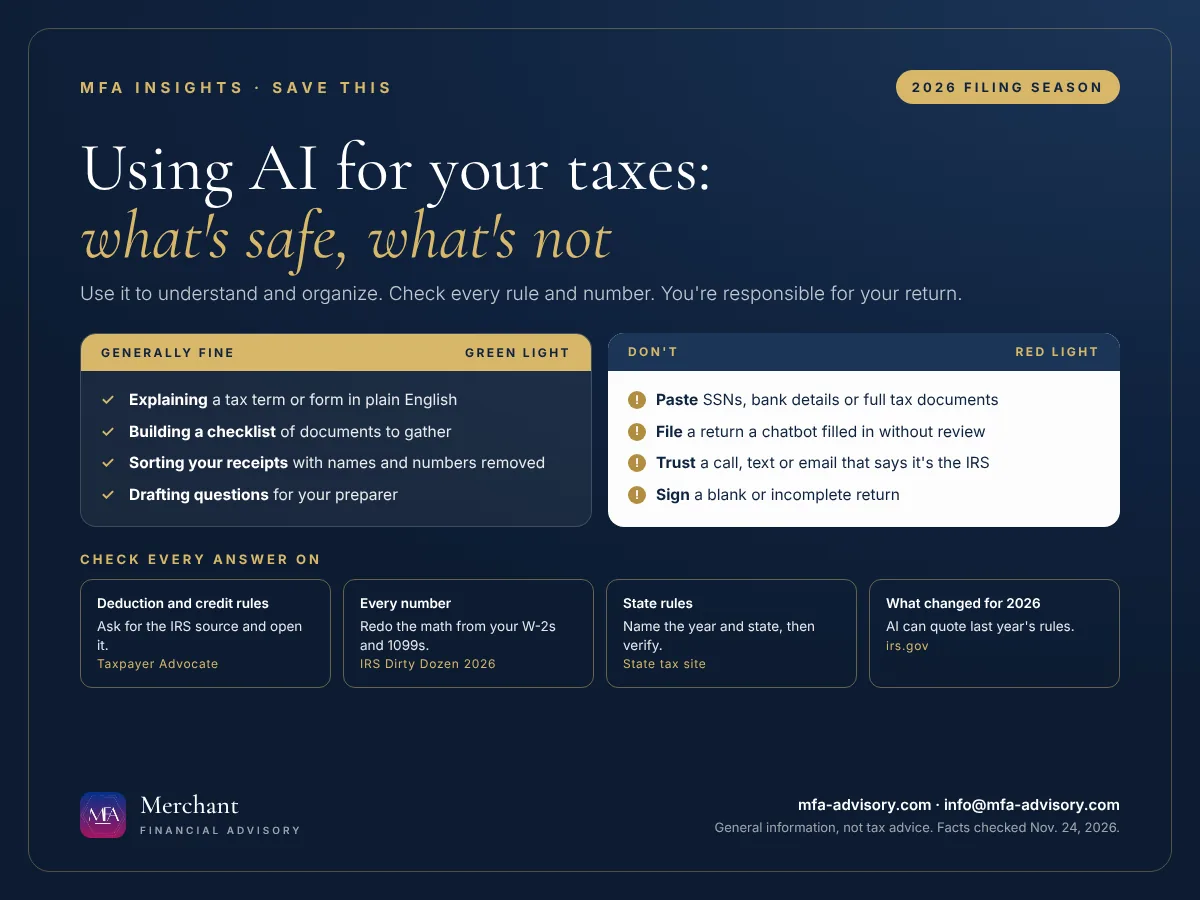
- Explaining a form or a term in plain English ("What is Schedule C?").
- Building a checklist of documents to gather before you file.
- Sorting your own receipts into categories, with names and numbers removed.
- Writing a list of questions for your preparer.
For bookkeeping, tools like ChatGPT for Accounting now draft entries and reconciliations inside QuickBooks and Xero for a person to review. The same rule applies: it drafts, you approve.
7 steps to use AI safely for your taxes
- Ask, don't hand over. Describe your situation in general terms. Leave out your name, Social Security number, address and account numbers.
- Name the year and state. Say "for the 2026 tax year, federal and New Jersey," then still check the answer.
- Ask for the source. Request the IRS form, publication or page, and open it yourself.
- Redo the math. Recalculate every number from your W-2s, 1099s and receipts.
- Don't file what you haven't reviewed. You're responsible for every line, and you should never sign a blank or incomplete return.
- Check who's preparing it. A paid preparer must sign the return and include a PTIN. A preparer who won't is a red flag, the IRS says.
- Ignore AI-voiced "IRS" calls and texts. Don't click links or open attachments from unexpected messages; send suspicious IRS emails to phishing@irs.gov.
FAQs
It can explain rules and help you get organized, but the Taxpayer Advocate says not to rely on AI answers to complex tax questions, and you stay responsible for your return. Check every rule and number before you file.
No. Leave out SSNs, bank and account numbers and full tax documents. Describe your situation in general terms instead.
You are. The Taxpayer Advocate says taxpayers are ultimately responsible for the information reported on their returns.
Yes. The IRS's 2026 Dirty Dozen list includes AI-enabled phone calls that impersonate the IRS. The IRS generally contacts taxpayers by mail first.
Yes, with care. IRS guidance for tax professionals says they must review anything AI drafts and keep client data in secure, approved tools.
Merchant Financial Advisory (MFA), an accounting, tax and business solutions provider in Princeton, New Jersey, prepares tax returns and keeps the books for individuals and small businesses in New Jersey and across the U.S.
Get key tax dates and new articles by email
Every new MFA Insights article, the IRS, New Jersey and New York deadlines that matter, and a calendar you can save. For individuals and small and mid-sized businesses.
Almost done: check your inbox and click the confirmation link to join MFA Insights. (If you don't see it in a minute, check Promotions or Spam.)
Have a question about this?
Ask us privately. Your question goes straight to our inbox, not onto the page, and we reply by email within one business day. Please don't include Social Security or account numbers.
Thanks, your question is in. We'll reply by email within one business day.
Sources
- Taxpayer Advocate Service: Is AI-generated tax advice making the grade? (updated Jan. 7, 2026)
- IRS: Dirty Dozen tax scams for 2026 (IR-2026-30, March 5, 2026)
- IRS Office of Professional Responsibility, Issue 2026-19: Introductory Guidelines for Responsible AI Use in Federal Tax Practice (June 24, 2026)
- IRS: Tips for choosing a tax professional
Facts checked against the sources above as of November 24, 2026. This article is general information, not tax, legal, or financial advice, and reading it does not create a client relationship. Tax rules change and every situation is different; confirm the details for your situation with a qualified professional before acting.