
The short version
- File now, even if you can't pay. The late-filing penalty is 5% of the unpaid tax a month. The late-payment penalty is 0.5%. Filing stops the bigger one.
- Extended to Oct. 15? File by Monday, Dec. 14, 2026. After 60 days late, a minimum penalty of $525 (or 100% of the tax, if less) kicks in.
- Owed a refund? There's usually no late-filing penalty, but you only have 3 years from the due date to claim it.
- New for 2025 returns: if you filed and paid on time for the 3 prior years, the IRS's automatic penalty relief may remove the penalties without you asking. Interest still applies.
Bottom line: Filing taxes late costs less than most people fear and more than it needs to if you keep waiting. File first, then deal with the balance.
If you missed the Oct. 15 extension deadline for your 2025 return, or never filed at all, the IRS hasn't forgotten about it, but this is very fixable. This guide to filing taxes late explains what the penalties actually cost, the one date that still matters this year, and what to do first.
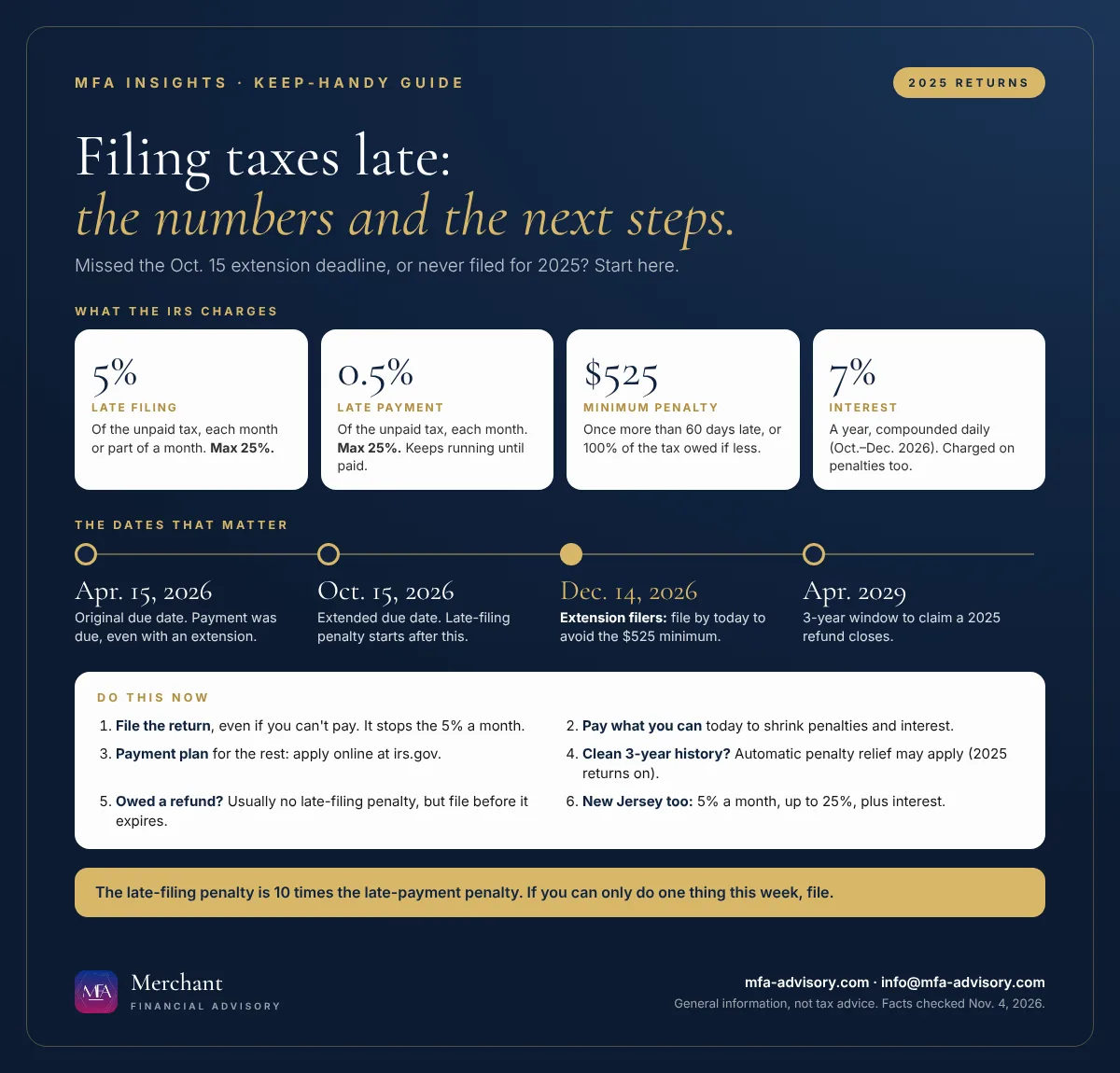
What happens if you file taxes late?
A late tax return penalty comes in two parts, plus interest. Both are based on the tax you still owe, not on your income.
| Charge | Rate | Cap |
|---|---|---|
| Failure-to-file penalty | 5% of the unpaid tax for each month or part of a month the return is late | 25% |
| Minimum late-filing penalty (more than 60 days late) | $525 or 100% of the tax owed, whichever is less (returns due in 2026) | n/a |
| Failure-to-pay penalty | 0.5% of the unpaid tax a month (0.25% on an approved payment plan if you filed on time; 1% if you ignore a notice of intent to levy for 10 days) | 25% |
| Interest | 7% a year, compounded daily (Oct. 1 to Dec. 31, 2026). The IRS also charges interest on penalties. | None |
When both penalties apply in the same month, the late-filing penalty is reduced by the late-payment penalty, so the combined charge is 5% a month. After 5 months the late-filing penalty maxes out, but the late-payment penalty and interest keep running until the balance is paid.
A part of a month counts as a full month. Filing on Nov. 16 instead of Nov. 14 can add a whole month of penalty.
Why Dec. 14 matters if you filed an extension
The late-filing penalty runs from your due date including extensions. If you filed Form 4868 in April, your 2025 return was due Oct. 15, 2026. The tax law sets a minimum penalty for returns filed more than 60 days after that date, and 60 days after Oct. 15 is Monday, Dec. 14, 2026.
The minimum hits small balances hardest. If you owe $500 and file after Dec. 14, the late-filing penalty can be the full $500, because the minimum is the lesser of $525 or 100% of the tax. File by Dec. 14 and it would be a small fraction of that.
Remember that the extension only gave you more time to file. Your payment was still due April 15, 2026, so late-payment penalties and interest have been building since then.
If you didn't file an extension
Your 2025 return was due April 15, 2026. By now the late-filing penalty has reached its cap and the minimum already applies. What you can still control is the late-payment penalty and interest. Both grow every month you wait, so paying sooner still saves money.
A rough example
Say you extended, owe $3,000, and file and pay on Dec. 1, 2026. That's 2 months late on filing (4.5% a month after the reduction, about $270) and 8 months late on payment since April 15 (0.5% a month, about $120), plus interest. These numbers are illustrative and rounded. The IRS calculates the exact figures and sends a notice.
New for 2025 returns: automatic penalty relief
In July the IRS announced the Automatic Exemption from Penalty (AEP), which replaces the old First Time Abate request process (IR-2026-83). It applies to eligible original returns starting with tax year 2025.
- Who qualifies: taxpayers who filed on time and paid any tax due in the 3 prior years.
- What it covers: failure-to-file, failure-to-pay and failure-to-deposit penalties are not assessed when the return is processed.
- What you do: nothing. If you qualify, the IRS sends a notice saying the relief was granted.
- What it doesn't cover: the tax itself and the interest. You still owe both.
The IRS is still phasing the program in, so some people who qualify may get a penalty notice for a 2025 return anyway. If that happens, contact the IRS and ask for First Time Abate. If you don't have a clean 3-year history, you can still ask for relief for reasonable cause, such as a serious illness or a disaster, with documents to back it up.
If you can't pay the full balance
File anyway, pay what you can, and set up an IRS payment plan for the rest. The IRS online options, based on combined tax, penalties and interest:
| Plan | Who can apply online | IRS setup fee online |
|---|---|---|
| Short-term (180 days or less) | Owe less than $100,000 | $0 (individuals) |
| Long-term, automatic monthly debit | Owe $50,000 or less and filed all required returns | $29 |
| Long-term, other payment methods | Same as above | $69 |
| Long-term, lower income | Same as above | $43, may be reimbursed |
Interest and some penalties continue on a plan until you've paid in full. The reduced 0.25% late-payment rate applies only if your return was filed on time, which is one more reason not to wait.
If you're owed a refund
The late-filing penalty is a percentage of unpaid tax, so if your withholding or estimated payments cover your bill, there's usually nothing to charge. The catch is the deadline: you must file within 3 years of the return's due date to claim the refund, which for 2025 means April 2029. The IRS also holds refunds while any other year's return is past due.
Late filing checklist: what to do this week
- Gather your 2025 forms. W-2s, 1099s and last year's return. Missing one? Ask the employer or payer, or request the wage and income data with Form 4506-T (check the box on line 8).
- Check for disaster relief. Some areas hit by disasters have IRS deadline postponements running into early 2027. Look up your area on the IRS disaster relief page before you assume you're late.
- File the return. Extension filers: by Dec. 14 if you can.
- Pay what you can now and apply online for a payment plan for the rest.
- Self-employed? Unreported self-employment income doesn't earn Social Security credits until the return is filed. Our Schedule C guide for single-member LLCs covers what goes where.
- Don't forget your state. New Jersey charges its own late-filing penalty (below).
New Jersey late filing penalties
New Jersey's late-filing penalty is 5% of the tax due for each month or part of a month the return is late, up to 25%. The Division of Taxation may also charge $100 for each month the return is late, a late-payment penalty of 5% of the tax due, and interest at the prime rate plus 3%, compounded annually. So filing your NJ-1040 at the same time as your federal return matters too.
FAQs
No. You can still file, and you should. Filing stops the 5% a month late-filing penalty from growing, and the IRS may file a substitute return for you if you don't, which may not include all the deductions you could claim.
5% of the unpaid tax for each month or part of a month late, up to 25%, plus 0.5% a month for paying late and interest at 7% a year. For returns due in 2026 that are more than 60 days late, the minimum is $525 or 100% of the tax owed, whichever is less.
The 60 days count from your extended due date, Oct. 15, 2026. File by Monday, Dec. 14, 2026 to avoid it.
Usually not, because the penalty is based on unpaid tax. You do need to file within 3 years of the due date or the refund is lost.
Yes. For 2025 returns, the Automatic Exemption from Penalty can remove late-filing and late-payment penalties if you filed and paid on time for the 3 prior years. Otherwise you can request First Time Abate during the transition, or relief for reasonable cause.
Merchant Financial Advisory (MFA), an accounting and tax solutions provider in Princeton, New Jersey, helps individuals and small and mid-sized businesses in New Jersey, New York and nationwide get behind-schedule returns filed and penalties under control. See our late 2025 tax return service and our Oct. 15 extension deadline guide, or book a consultation.
Save the key dates
- Mon, Dec 14, 2026Extension filers: file your 2025 return by today to avoid the IRS minimum late-filing penalty 60 days after the Oct. 15, 2026 extended due date. After this, the failure-to-file penalty is at least $525 or 100% of the tax owed, whichever is less.
Add to calendar
Subscribe to every MFA key date
"Add all these dates" downloads one file that opens in Apple Calendar, Outlook or Google Calendar (in Google, use Settings, then Import). Subscribing works with Apple, Google and Outlook and updates itself whenever we publish a new deadline.
Get key tax dates and new articles by email
Every new MFA Insights article, the IRS, New Jersey and New York deadlines that matter, and a calendar you can save. For individuals and small and mid-sized businesses.
Almost done: check your inbox and click the confirmation link to join MFA Insights. (If you don't see it in a minute, check Promotions or Spam.)
Have a question about this?
Ask us privately. Your question goes straight to our inbox, not onto the page, and we reply by email within one business day. Please don't include Social Security or account numbers.
Thanks, your question is in. We'll reply by email within one business day.
Sources
- IRS: Failure to file penalty (reviewed Oct. 5, 2026)
- IRS: Failure to pay penalty (reviewed Oct. 23, 2026)
- 26 U.S. Code § 6651: Failure to file tax return or to pay tax
- IRS IR-2026-98: Interest rates remain the same for the fourth quarter of 2026
- IRS: Payment plans; installment agreements (reviewed Aug. 13, 2026)
- IRS IR-2026-83: IRS simplifies penalty relief, introduces automatic process for eligible taxpayers
- IRS Tax Tip 2026-59: Eligible taxpayers may receive automatic penalty relief
- IRS: Administrative penalty relief (reviewed Oct. 22, 2026)
- IRS: Penalty relief for reasonable cause (reviewed June 21, 2026)
- IRS: Filing past due tax returns (reviewed May 7, 2026)
- IRS: Tax relief in disaster situations
- NJ Division of Taxation: When to file and pay (updated May 18, 2026)
Facts checked against the sources above as of November 4, 2026. This article is general information, not tax, legal, or financial advice, and reading it does not create a client relationship. Tax rules change and every situation is different; confirm the details for your situation with a qualified professional before acting.