
Executive summary
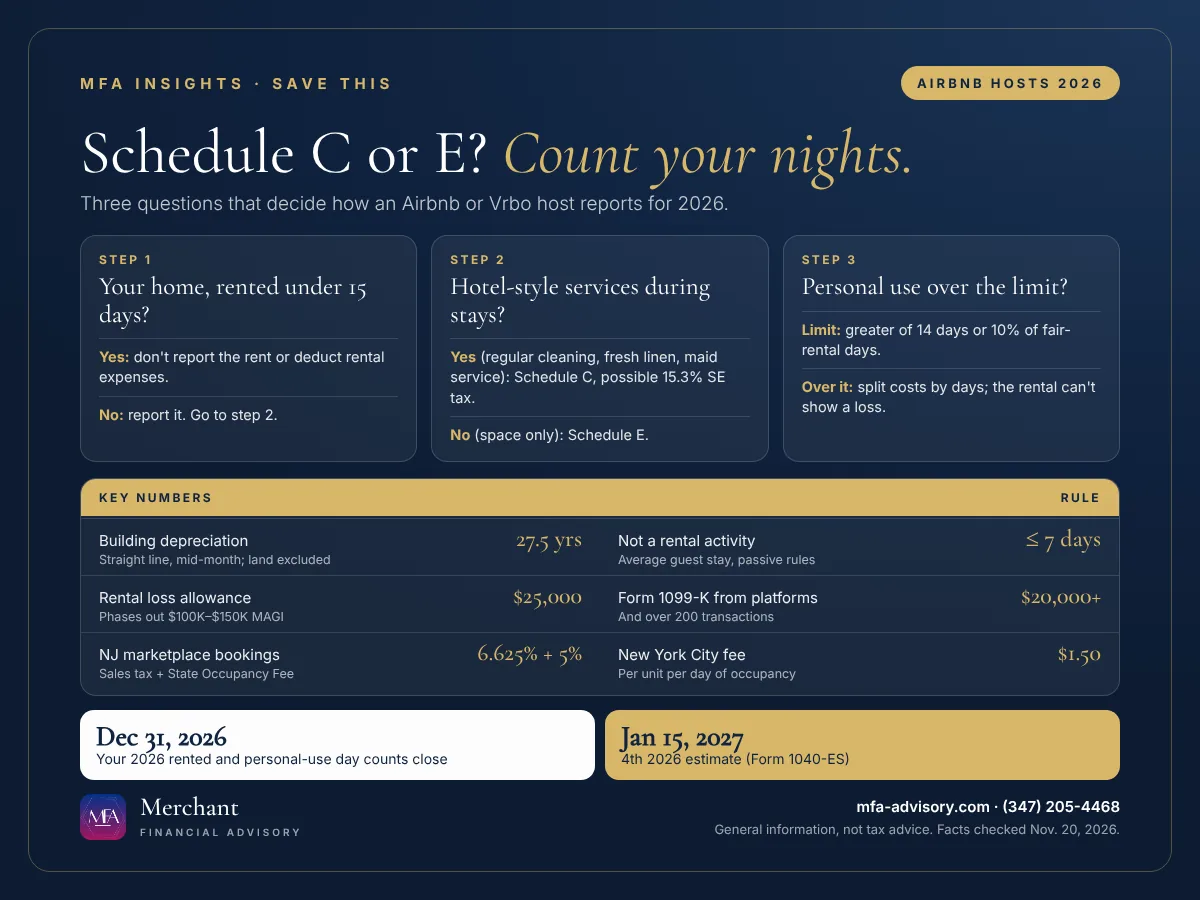
- Most Airbnb hosts report on Schedule E. If you give guests substantial services, like regular cleaning during a stay, changing linen or maid service, the income goes on Schedule C and may owe 15.3% self-employment tax.
- The 14-day rule: if the place is also your home and you rent it fewer than 15 days, you don't report the rent at all.
- Personal-use limit: stay more than the greater of 14 days or 10% of the nights rented at a fair price, and the rental can't show a loss.
- NJ and NY: marketplace bookings in New Jersey carry 6.625% sales tax and a 5% State Occupancy Fee; New York requires booking services to collect sales tax.
Bottom line: Count your 2026 rented and personal nights before December 31, then pick the schedule from the services you actually provide.
Airbnb host taxes come down to two questions: what you provide and how often you stay there. Space only, with cleaning between guests, usually goes on Schedule E. Hotel-style services during stays move the income to Schedule C. If the place is also your home, the 14-day rule and the personal-use limit decide what you report and deduct.
Is Airbnb income reported on Schedule C or Schedule E?
For the Airbnb Schedule C or Schedule E question, the answer is usually Schedule E. IRS Topic 415 says rental income and expenses are generally reported on Schedule E (Form 1040).
The exception is services. IRS Publication 527 says that if you provide substantial services mainly for your guests' convenience, such as regular cleaning, changing linen or maid service, you report the income and expenses on Schedule C. You may also owe self-employment tax on Schedule SE.
Heat and light, trash collection and cleaning of common areas don't count as substantial services. Decide from what you actually provide, not from what the platform calls you.
| Your setup | Form | Self-employment tax |
|---|---|---|
| Space only, cleaning between guests | Schedule E | Generally no |
| Regular cleaning, fresh linen or maid service during stays | Schedule C | Possibly, 15.3% on net earnings of $400 or more |
| Your home, rented fewer than 15 days | Not reported | No |
What is the 14-day rule for Airbnb?
If you use a dwelling as a home and rent it for fewer than 15 days in the year, you don't report any of the rental income. You also don't deduct any expenses as rental expenses. That's straight from IRS Topic 415.
The rule only helps if the place is also your home. A property you never stay in doesn't get it, so even a few paid nights are reported.
How many personal days can an Airbnb host use?
The IRS treats a rental as your home when your personal-use days are more than the greater of 14 days or 10% of the days you rent it at a fair price. Rent it 200 nights and your limit is 20 personal days.
Airbnb personal use days include days used by you, anyone with an interest in the property, family, and anyone paying less than a fair rent. A day you spend working substantially full time on repairs and maintenance isn't a personal day, even if family uses the place that day.
Go over the limit and you still deduct the rental share of expenses, but not more than your rental income. The rental can't show a loss. Some unused expenses carry forward to the next year.
What can Airbnb hosts deduct?
Airbnb host tax deductions follow the usual rental rules. If you also use the place yourself, divide expenses between rental and personal use by the number of days used for each. Rented 120 nights and stayed 30? About 80% of shared costs is the rental share.
- Cleaning, supplies and linens for guests.
- Platform service fees withheld from your payouts.
- Utilities, insurance, repairs and the rental share of mortgage interest and property tax.
- Depreciation on the building over 27.5 years, straight line, mid-month convention (Pub 527). Land isn't depreciated.
Not sure if a project is a repair or an improvement? Read our rental repairs vs improvements guide, then try the rental depreciation calculator.
What is the short-term rental 7-day rule?
IRS Publication 925 says an activity isn't a rental activity if the average guest stay is 7 days or less. The same applies at 30 days or less if you provide significant personal services.
That matters for losses. The $25,000 special allowance for rental real estate phases out between $100,000 and $150,000 of modified AGI, and it's for rental real estate activities, so it generally doesn't help when the activity isn't a rental activity. Whether a short-term rental loss can offset your wages then depends on material participation. Two of the tests: more than 500 hours a year, or more than 100 hours and at least as much as anyone else.
Airbnb host tax numbers at a glance
| Rule | Number | Source |
|---|---|---|
| Not reported if your home is rented | Fewer than 15 days | IRS Topic 415 |
| Personal-use limit | Greater of 14 days or 10% of fair-rental days | IRS Topic 415 |
| Residential rental depreciation | 27.5 years | IRS Pub 527 |
| Not a rental activity (passive rules) | Average stay 7 days or less | IRS Pub 925 |
| Rental loss allowance | Up to $25,000; phases out $100,000 to $150,000 MAGI | IRS Pub 925 |
| Self-employment tax (Schedule C hosts) | 15.3% from $400 of net earnings | IRS Topic 554 |
| Form 1099-K from platforms | Over $20,000 and over 200 transactions | IRS |
No 1099-K? The IRS says all income is taxable unless the law says otherwise, even without one.
Airbnb taxes in NJ and NY
- New Jersey: rentals booked through a transient space marketplace carry 6.625% sales tax and a 5% State Occupancy Fee, plus any municipal occupancy tax. The marketplace collects and remits them. Since August 9, 2019, a rental booked directly from the owner isn't subject to sales tax unless it's a professionally managed unit.
- New York: TB-ST-331 says operators and booking services must collect sales tax on short-term rental occupancy when the rate is more than $2 a day. A booking service that facilitates your rental collects it. An owner renting directly for 3 days or less in a year doesn't.
- New York City: operators and booking services also charge a $1.50 per unit per day fee.
When are 2026 estimated taxes due for hosts?
Nobody withholds tax from your payouts. The last 2026 estimate is due January 15, 2027 with Form 1040-ES. You can skip it if you file your 2026 return by February 1, 2027 and pay the full balance.
FAQs
Usually not on Schedule E. If you provide substantial services and report on Schedule C, self-employment tax of 15.3% may apply once net earnings reach $400.
Not by itself. The IRS points to services during stays, like regular cleaning, changing linen or maid service, mainly for the guest's convenience.
Yes. Platforms send a 1099-K over $20,000 and 200 transactions, but the income is taxable either way.
No, if you work substantially full time on repairs and maintenance that day.
Merchant Financial Advisory (MFA), an accounting, tax and business solutions provider in Princeton, New Jersey, prepares Schedule E and Schedule C returns for Airbnb and Vrbo hosts and landlords in New Jersey, New York and nationwide. Read our Schedule C guide, check your setup with the Airbnb host tax checker, then see rental property taxes with MFA.
Related MFA service: Tax preparation and filing. Questions first? Book a consultation.
Save the key dates
- Thu, Dec 31, 2026Airbnb hosts: last day that counts toward 2026 rental and personal-use days Your 2026 day counts (rented at a fair price vs personal use) close today. Personal use over the greater of 14 days or 10% of fair-rental days means the place counts as your home.
Add to calendar
- Fri, Jan 15, 20274th 2026 estimated tax payment due (Form 1040-ES) Not needed if you file your 2026 return by February 1, 2027 and pay the entire balance due with it.
Add to calendar
Subscribe to every MFA key date
"Add all these dates" downloads one file that opens in Apple Calendar, Outlook or Google Calendar (in Google, use Settings, then Import). Subscribing works with Apple, Google and Outlook and updates itself whenever we publish a new deadline.
Get key tax dates and new articles by email
Every new MFA Insights article, the IRS, New Jersey and New York deadlines that matter, and a calendar you can save. For individuals and small and mid-sized businesses.
Almost done: check your inbox and click the confirmation link to join MFA Insights. (If you don't see it in a minute, check Promotions or Spam.)
Have a question about this?
Ask us privately. Your question goes straight to our inbox, not onto the page, and we reply by email within one business day. Please don't include Social Security or account numbers.
Thanks, your question is in. We'll reply by email within one business day.
Sources
- IRS Topic 415, Renting residential and vacation property
- IRS Publication 527 (2025), Residential Rental Property
- IRS Publication 925 (2025), Passive Activity and At-Risk Rules
- IRS Topic 554, Self-employment tax
- IRS: Form 1099-K FAQs, general information
- IRS: 2026 Form 1040-ES, Estimated Tax for Individuals
- NJ Division of Taxation: TB-81R2, Taxes Imposed on the Rental of Transient Accommodations
- NJ Division of Taxation: Transient accommodations FAQ
- NY Department of Taxation and Finance: TB-ST-331, Hotel and Short-Term Rental Unit Occupancy
Facts checked against the sources above as of November 20, 2026. This article is general information, not tax, legal, or financial advice, and reading it does not create a client relationship. Tax rules change and every situation is different; confirm the details for your situation with a qualified professional before acting.